Showing posts with label Author. Show all posts

Sunday, April 18, 2021

Naval Historical Foundation: Brown Water Bluejackets


I was recently asked to participate in this round table discussion on Vietnam Riverine Warfare in the Mekong Delta.  Although lengthy, its quite a fascinating mix of historical and first hand perspectives of the role of the Navy in the Delta region and how they leveraged a unique mix of assets and strategies to keep the waterways safe and navigable.

"This panel of historians and veterans relate their first hand experiences containing an excerpt from Admiral Zumwalt's memoir On Watch describing his innovative approach to riverine operations in Vietnam, as well as vignettes detailing the in-theater experiences of Vice Admiral David Robinson, Captain Richard Krulis, and Lieutenant Rolland Kidder, three veterans of the brown water warfare who discuss the war in greater depth as part of an ongoing webinar series on naval history."


Rolland Kidder


Saturday, November 28, 2020

Too Big to Fail


Back in 2008, during the financial crisis, we were introduced to the words: “too big to fail,” referring to banks that had to be saved because they otherwise could take down the whole economy.  The legislation that was then passed was intended to provide warning signs and protections so that, in the future, these companies couldn’t fail.

Despite all of these efforts, I think we must admit that we still have companies that are “too big” or “too important” to let them fail. One of these companies is Boeing.

Boeing got itself into deep trouble by rushing the 737 Max passenger jet into production.  The 737 airframe had been around for 20 years, and had become a big money-maker for Boeing.  In aviation, it is always quicker and easier to make changes to an existing air-frame than in asking for FAA certification for a new design.  If you build or a design a new airplane, it takes years (usually) to get it tested and flight approved.  

Boeing had kept adding seats, carrying capacity and bigger engines to the 737, but in going to the Max, they really “maxed” it out.  In order to accommodate new and larger engines, they had to move the engines forward and higher so that there was enough ground clearance.  This changed the stall and stability characteristics of the plane.  A new computer was designed to address this problem, but the needed sensors and, especially, new training on how to operate the system—were not made available to all who flew or purchased the new plane.  Two 737 Max planes went down within months of each other, and the plane was grounded.

Though not currently flying, but as one who has loved aviation having been a pilot with a commercial, instrument multi-engine rating — I found the story of the Boeing 737 Max to be especially distressing. Profitability and aircraft production targets trumped safety, and we have ended up with our premier large American aircraft company sitting on the edge of bankruptcy.  It has been a sad story.

Recently, the news has been better.  The FAA has announced its approval for the 737 Max to fly again. The aircraft’s computer control system has been improved, and all pilots must now be trained in how that works.  In addition, the federal government made the company eligible for billions of dollars in financial aid to keep Boeing afloat.

In the end, Boeing didn’t need the federal aid—just the promise of it propped up the credit markets and Boeing was able to float a multi-billion-dollar bond issue of its own.

All of this has pointed to an inconvenient truth. Some of our companies are so important to our economy and national security that we can’t let them fail.

But, all of this has pointed to an inconvenient truth.  Some of our companies are so important to our economy and national security that we can’t let them fail.  There is nothing that our adversaries like China and Russia would like to see more than a company like Boeing going under.  We can’t let that happen.

Maybe we have learned a lesson.  When it comes to air safety, the FAA must reassert its authority and its independence over the matter of certifying or re-certifying aircraft for commercial flight even if this means slowing the process down.  We will not have a robust and growing airline industry again until the flying public has the confidence and trust that the planes it flies in are, in fact, safe to fly. 


Rolland Kidder


Sunday, March 15, 2020

We were fortunate for 18 years with Amo Houghton

I first got to know Amo Houghton in the mid 1970s when I represented Chautauqua County in the New York State Assembly. He was chairman of Corning Inc. and would periodically call together all of the state elected officials representing the Southern Tier to discuss common problems and issues facing the region.

Amo Houghton reflects here on his service to the Western New York community in
his remarks from 2004 at the Robert H. Jackson Center.

Usually, I would receive a call from Reggie Lenna or Quint Anderson, two local business leaders, and they would coordinate the schedule.

State Senator Jess Present and I would meet Reggie and Quint at the Jamestown Airport. We would fly to Olean, pick up Assemblyman Dan Walsh and then head to Corning.

Walsh and I were Democrats and most everyone else was Republican. But that didn’t make any difference. We were going to Corning to talk about jobs, the economy and what we could do jointly to help advance the region. Amo would chair the meeting.

In 1986, when then Congressman Lundine announced that he was running for Lieutenant Governor, Stan called and asked me to consider running for the Congressional seat. I declined the opportunity. Fortunately, that was one of the smarter (or luckier) political decisions I made in my life because Amo Houghton soon thereafter made the announcement that he would seek the post.

It was pretty much a foregone conclusion that a Democrat was not going to beat a highly respected business leader like Amo Houghton in a district which was and still is a Republican bastion.

Amo didn’t need the job of Congressman. He had plenty of money and had recently retired from a successful career at Corning as head of a Fortune 500 Company.

He was running because he wanted to help grow and advance the Southern Tier.

He actually had been considering becoming a missionary in Africa for the Episcopal Church when the Congressional seat opened. I have always thought that, in a way, he chose Congress as an alternative missionary project, giving him an opportunity to represent and help his home community.

I have always thought that, in a way, he chose Congress as an alternative missionary project, giving him an opportunity to represent and help his home community.

Among other accomplishments, Amo was a World War II Marine veteran and was very supportive of efforts I became involved with in Washington to build a National World War II Memorial. Periodically, I would stop by his office on Capitol Hill and update him on where we were with the project.

Amo was always fighting to keep his Republican Party in the middle of the road.

My father would have described him as an “Eisenhower Republican.” Amo was also not afraid to “buck” his own Party when he believed they were going in the wrong direction.

The last time I saw him was about a year ago. I stopped and had coffee with him in the old family residence in Corning. His grandfather had built the home on a hill that overlooked the glass company’s factory down below. Though he also had a house in Massachusetts, for Amo, Corning was always home.

It was here where he wanted to spend his last days.

This is where his heart was.

We are fortunate that for 18 years this great man represented us in the United States House of Representatives.

Rolland Kidder 
This commentary originally appeared in The Post Journal on Mar 14, 2002  


Sunday, February 16, 2020

State of our Union


“The state of our union is good” if you are talking about the recent Super Bowl. Not so good if you watched the action recently in the House of Representatives.

How can things “be good” when the President won’t shake the hand of the Speaker and she responds by ripping up his speech?


Whether you are a Republican or a Democrat this was a sad spectacle to behold.

On the other hand, at the Super Bowl, World War II veterans made the honorary coin-toss to start the game, America the Beautiful and the Star-Spangled Banner were sung, and then we were treated to one of the best football games ever. It was a battle between a mid-America team, Kansas City, and a west coast urban team, San Francisco.

Yet, nobody was shouting “coastal elites” or “mid-west rednecks!” Nobody cared about the Republicans vs. the Democrats. All in the stadium (and millions on TV) were experiencing America as it is and, in the process, enjoying each other.

There was NFL Commissioner Roger Goodell sitting next to an African-American player’s union representative. There was Coach Andy Reid being hugged by his black and white players after an incredible come-back victory. The game was a pure American slugfest followed by a hug-fest.

I didn’t particularly like the half-time show which I thought was a bit bawdy and risqué. Yet, some of the younger, female members of our family viewed it as a Latino, female affirmation for women. But, in any event, nobody was arguing the politics of it.

I can remember when black Americans were not allowed as students at universities in Mississippi and Alabama. Now, college football teams in the South are often, in racial make-up, more black than white. I can remember when it was illegal in some states for people of opposite races to marry… it was called “miscegenation.” This year the MVP of the Super Bowl came from a mixed-race family.

This is the America we have become, and it is something to celebrate. In our diversity, the “state of the union” is good.

Maybe it takes a good football game, like this year’s Super Bowl, to wake us up a bit. We are a better country than our current politics would indicate. We can compete, be different and still get along.

We will find our way through all of this. There is light at the end of the tunnel. Maybe it takes a football game to show us that there is even light in the tunnel.


Rolland Kidder


Wednesday, February 12, 2020

Time Marches On


Recently, thanks to a good buddy who helped with the driving, I took a road-trip to Chicago and the Midwest to see two old friends.  Both are experiencing what could be life-ending health issues.

It was a reminder that “time marches on,” and that there is nothing you can do about getting old.  It was also an energizing trip in that life-long friendships never get old.


Both of these men were educated in theology.  One I met while in seminary, and he had a remarkable 40-year career in the Christian ministry.  Both have counseled many over the years on the issues facing those nearing the end of their lives.  Now they are living it.

The experience caused me again to pick up the book “Being Mortal” by Atul Gawande which I keep on the reading table next to my bed.  There is a lot of good reading in that book.

I told my doctor once that this book should be mandatory reading for everyone reaching retirement age.  It puts a lot of things in perspective.  The underlying message is that aging is inexorable and irreversible.  We can deal with it or not.  We can affirm or deny it.  We can ignore it… but it is not going to go away.

We can deal with it or not.  We can affirm or deny it.  We can ignore it… but it is not going to go away.

The one thing that we cannot really control is how we will die.  I remember my Mom always saying that she wanted to die quickly without a lot of drawn out pain and anxiety.   Her prayers were answered.  During a hospital stay for heart-related issues, one night after a walk with an aide, she toppled into bed and was gone.  On the other hand, my Dad died a prolonged death from cancer, sort of wilting away a day at a time until the end of his life.

Maybe what the elderly fear most is not being in control.  For all of their adult lives, they were working jobs and running households.  They were “in charge.”  Now, they are subject to events beyond their control.  In the case of my friend in Chicago, he seemed most concerned about the ill-health of his wife.  She has her own problems with dementia and needs lots of care.  Yet, with his own declining physical condition, he is not able to provide it and must depend upon others.

In most cases, doctors are at the forefront in all of this.  My own doctor has been seeing me for over 30 years and has been spectacularly successful in keeping this “old used car” running.  Yet, he has also been there when there have been bumps in the road.  He has seen hundreds of patients over the years move through their life cycle.   He will be there at the end doing whatever he can to provide good health care to his patients.  This is what doctors do.

If there is a gold star award in heaven, it should go to those in the medical community who dedicate themselves to lifetime patient care.

There is, of course, a spiritual and emotional dimension through all of this.   Faith, friendship and the love of family are most important as one reaches the end.

These two friends I visited had a great, positive impact on my life.  I felt a need to visit them at this time in their lives.  I hope that the visit was as meaningful to them as it was to me.

Rolland Kidder


Saturday, January 25, 2020

Republicans Struggle in Albany


I am a Democrat, so it might seem strange for me to be concerned about the future of the Republican Party in Albany… but such is the case. Though the Republican Party is dominant here and in many Upstate areas—as a statewide political force, it is in decline.

Today, the Republican Party has no state-wide elected leaders, and is falling into a permanent minority status in the state legislature. Competition in politics is a good thing and right now the Republican Party in New York is not providing it.

Competition in politics is a good thing and right now the Republican Party in New York is not providing it. 

During the years I was in Albany, the Republicans controlled the State Senate and were a check on the policies of the Democratic Party in the Assembly. Yet, the situation also created an opportunity for Chautauqua County. Most of the legislation I passed in the Assembly was co-sponsored in the Senate by my good friend, Republican Jess Present. As a result, we got a lot done in Albany for the people of the area. Our both being in the majority meant that we could deliver for our constituents.

Republicans in the State Assembly have been in the minority since 1975. They recently experienced a “bump in the road” when their Minority Leader was picked up driving drunk in a state car which he is eligible to have as a legislative leader. The optics weren’t good. He quickly announced his resignation as Republican Leader.

Now, it has been announced that an Assemblyman from the Oswego Area will lead the Republicans in the Assembly. I thought that it might have been an opportunity for our Assemblyman, Andy Goodell, but he indicated that he would not seek the position preferring to retain his role as floor leader. Yet, the reality is that the Republicans only have 43 of the 150 seats in the Assembly and so their power in Albany is minimal.

Until last year, the Republicans in the State Senate were in a much better position—they were in the majority and had great influence in the budget and legislative process. However, they lost the Majority in the last election and now have only about 1/3 of the seats in the Senate. Many incumbent Republican Senators have since announced their retirements or are seeking other offices (like running for Congress.) Therefore, chances of Republicans regaining control of the State Senate seem nil at this point.

Being in the Majority, they were able to draw Senate districts which favored Republicans being elected.  This time around in the “gerrymandering” process, they won’t be in that position.  

Another “nail in the coffin” for Senate Republicans is that after the 2020 census, there will be a redrawing of legislative district lines. Assuming that they are not in the Majority, they will probably lose even more seats in that legislative body. By being in the Majority, they were able to draw Senate districts which favored Republicans being elected. This time around in the “gerrymandering” process, they won’t likely be in that position.

Perhaps a “white knight” will come charging to the fore and win the Governorship for the Republicans. Aside from that possibility, I see little happening in Albany to change the current state of affairs. It would better for all of us if the Republican Party could find a way to resurrect itself and again become a competitive force in New York politics.


Rolland Kidder


Saturday, December 14, 2019

The Demise of Political Parties


From the time I was a kid, there has been a big change in the way political parties operate. There used to be robust political conventions where state delegations dominated, and the nominees for President were decided. Today, all of this has all shifted to a Primary election format where the nominating process goes on “forever,” and the winner often ends up being the person who can raise the most money.

Four years ago, it was the Republican Party battling it out. This year it is the Democrats. It has become a circus in a way. Candidates with the most extreme positions tend to move toward the “front of the pack” in both parties, and the so-called debates have become exercises in who has the better “show-biz” techniques. It is a tiresome and demeaning process.

Right now, the Democrats still seem far from selecting a middle-of-the-road candidate who could win the general election. In comparison, the Republicans, appear to be solidly lining up behind their real estate tycoon and self-made reality show personality from Queens and are following him like the Pied Piper to an end yet to be determined.

Political parties, like people, have a history. Just think back to over 50 years ago when the 1965 Civil Rights Act was passed. From shortly after the end of the Civil War until then, the South had been solidly Democratic. Now the “solid South” is Republican. States like New York back then could elect Republicans statewide, now there are no Republican statewide elected officials in our State. Political parties are not what they used to be.

The Democratic Party really doesn’t exist much except as a debate forum for people who either have money or can raise a lot of it.

I attribute a lot of this to the power of money in American politics. When Senator John McCain was alive, he and Senator Feingold sponsored bi-partisan legislation to limit the impact of money on politics. That legislation was thrown out by the Supreme Court. So, look what happened. Now, in the Democratic race for President, you are not eligible to join Presidential debates unless you can raise money, and then keep raising more money. The Democratic Party really doesn’t exist much except as a debate forum for people who either have money or can raise a lot of it. Similarly, the Republican Party of pro-business and small government seems to have disappeared into a personality cult of some kind.

Where are the political parties in terms of their own status in American political history? This may be too simplistic, but I see the Republican Party as morphing back into the Whig Party of the 1850s from whence it came. The Whigs became known as the “know nothing” Party. They preached fear of immigrants and urbanization, became insular in their politics and ultimately became irrelevant. All of this talk today of building a wall to keep people out and spreading fear about immigrants, etc. reminds me a lot of the 1850 Whigs.

And where is the Democratic Party? Again, some might take issue with this, but I see it struggling like it did in the 1920s. It didn’t have focus, the old “solid south” and urban north hadn’t figured out how to build a winning coalition. It took the Great Depression and Franklin D. Roosevelt to do that.

Yet, back in those days, the national party conventions at least had a purpose. They were the center of power for nominating the Presidential candidates. Today, they have become a coronation affair for a big money/media game and that is not good for the country.

Rolland Kidder 

Saturday, October 12, 2019

The Nixon Tapes and Now

I had predicted in an earlier article that the Democrats in the House would not bring impeachment proceedings against Donald Trump. I was wrong. After revelations of his conversation with the President of Ukraine, Nancy Pelosi, Speaker of the House, authorized an “inquiry” into impeachment proceedings against the President. 


My earlier prediction was based upon the fact that impeachment would fail in the U.S. Senate; and so why waste the time of the people of the United States in an effort which was doomed to failure? What has changed is the President’s own recent admission that he was trying to influence a foreign government to bring down Joe Biden.

So far, we have been getting “redactions” and summations of what the President said to the leader of Ukraine. A “whistleblower,” still unknown, says that the White House has covered up the complete conversation of the President. It all reminds me a bit of 1974.

In the Watergate scandal, there was an inside source, known as “deep throat” who “spilled the beans” about the break-in at the Democratic headquarters in D.C. When it became known that the President knew of and had authorized the operation and that there had been a taped conversation and a cover-up–a subpoena was issued for the tape. That matter went all the way to the U.S. Supreme Court and in a unanimous decision the Court essentially ordered the White House to give up the tape.  (United States v. Nixon, 1974)

When that happened, we all know what happened next. President Nixon got in his helicopter, gave his last “V” for victory salute, and relinquished the Presidency to Vice President Gerald Ford. He was then pardoned by the new President Ford, and the country moved forward.

There are differences today but also similarities. Assuming that the “inquiry” by the House results in articles of impeachment, the matter will end up in the U.S. Senate. There, the future of Donald Trump’s Presidency will be in the hands of his own party. In 1974, though Democrats were in the majority in the Senate, Republican Senators controlled the impeachment process because 67 votes (two-thirds) were needed for conviction. When the tapes were ordered released, a group of Republican Senators, including Barry Goldwater, went to the White House and told President Nixon that probably only 15 Senators would support him, far less than needed to stop an impeachment. 

“I could stand in the middle of 5th Avenue and shoot somebody and I wouldn’t lose any voters. It's like, incredible.”     – Donald Trump

President Trump said during his last campaign that his supporters would back him, no matter what he did. “I could stand in the middle of 5th Avenue and shoot somebody and wouldn’t lose any voters,” he said, “It’s, like, incredible.” That sentiment could continue to hold, or it could change depending on what more comes out during the inquiry.

U.S. Senators tend to have a longer-term view of things. The framers of the Constitution gave them longer terms (6 years) than either the President (4 years) or Representatives in the House (2 years.) That is probably why Senators were given the last say in something as serious as removing a President from office.

If evidence builds that President Trump violated his oath of office or committed a crime, it is possible that history could repeat itself and we could have President Pence in the White House before this is over.

Rolland Kidder
This article first appeared in The Post Journal.


Sunday, July 28, 2019

Words Make a Difference


Words, especially those used by national leaders, make a difference.

The words that President Trump used in three “tweets” on, Sunday, July 14th were especially divisive. This is what he said:

Donald Trump:
“So interesting to see ‘Progressive’ Democrat Congresswomen, who originally came from countries whose governments are a complete and total catastrophe, the worst, most corrupt and inept anywhere in the world [if they even have a functioning government at all], now loudly and viciously telling the people of the United States, the greatest and most powerful Nation on earth, how government is to be run. Why don’t they go back and help fix the totally broken and crime infested places from which they came. Then come back and show us how it is done. These places need your help badly, you can’t leave fast enough. I’m sure Nancy Pelosi would be very happy to quickly work out free travel arrangements.”

That those in his base would be shouting “send her back!” at his next political rally should not come as a great surprise.

A little more than a week earlier, the President had stood on the steps of the Lincoln Memorial on the 4th of July. I wish that he had gone inside and read the words of Lincoln. Lincoln was a President, presiding over a much more divided Nation, then engaged in a catastrophic Civil War. The words of Lincoln in his second inaugural address did not attack, they did not blame, they did not attempt to divide. They were words of prayer, healing and of restoring unity to a torn country, and ended with hope for a better time: 


Abraham Lincoln:
“With malice toward none, with charity for all, with firmness in the right as God gives us to see the right, let us finish the work we are in, to bind up the nation’s wounds, to care for him who shall have borne the battle and for his widow and his orphan, to do all which may achieve and cherish a just and lasting peace among ourselves and with all nations.”

Words make a big difference. They also reflect the character of those who speak them. We need to be healing the Nation’s wounds, not promoting divisions based on our fears or differences. That may be an effective election strategy, but it is not the American way that I was taught. 


Rolland Kidder
This commentary appeared in the The Post Journal on July 28, 2019


unsplash-logoDan Girgis

Thursday, July 11, 2019

D-Day is a time to reflect


National World War II Memorial, Washington, D.C.

For the past decade or more, I have been on the Board of an organization, Friends of the World War II Memorial, that helps sponsor events at the National World War II Memorial in Washington, D.C.  Though we co-sponsor five days of national commemoration with the National Park Service, including Veterans Day and Memorial Day, perhaps our biggest event took place this year with the 75th Anniversary of D-Day, June 6, 1944.

D-Day is not an official holiday in the United States. The Post Office stays open, kids go to school and life goes on as usual. Yet, something deep in the American psyche is touched on D-Day. The nation can’t or won’t let it go.

Everything, of course, about what happened on D-Day was big: the largest amphibious attack force in world history, the courage displayed in places like Omaha Beach and Point Du Hoc, the decision to delay the invasion for a day because of the weather, the struggle to get off the beaches in Normandy and begin the liberation of Europe. Freedom itself was at stake and victory wasn’t guaranteed.

But today what seems to motivate its remembrance by Americans is the nostalgia of a better time. A time when Americans were all “pulling on the same oar,” when our goals and objectives were clear and people responded to the call. There is yearning to again recapture that spirit.

It almost seems impossible to conceive of something like D-Day happening again. It is hard to even comprehend such a world-wide conflict and one wonders whether civilized society would have the strength and resilience to rise up and defend itself today if we faced a similar challenge.

One of our Board members, Elliott “Toby” Roosevelt III, great grandson of President Franklin Roosevelt, reflected this year on the occasion of the 75th anniversary suggesting that the nation’s feelings about D-Day relate to the idea of sacrifice:

“When compared to the sacrifices of the men who hit the beaches of France on that day… few of us have given much to merit the freedoms and protections we have enjoyed our entire lives.
- Freedoms and protections we love;
- Freedom and protections that we take for granted; and
- Freedoms and protections which the vast majority throughout history, have never known. 
When we were born, these were simply handed to us.”

Toby Roosevelt has a point. It could be the fact that others sacrificed for the greater good to preserve the freedoms we now enjoy–that makes D-Day so important. Whatever the reason, June 6 has become one of those days when we stop and ponder what it means to be American.

Rolland Kidder
This commentary first appeared in The Post-Journal on June 30, 2019


unsplash-logoJared Short


Sunday, May 19, 2019

Republicans are Bailing


It is not usually newsworthy when a state legislator switches political parties, but, recently, a news article caught my eye when the longest serving Republican legislator in the Iowa General Assembly announced that he was switching political affiliation to the Democrats. How could that be?

I did some research on this gentleman, named Andy McKean, and found that he had served both in the Iowa State Senate and the Assembly for a total of 24 years. The reason he gave for switching parties is that Donald Trump had become the face of the Republican Party.

“I believe that his actions have coarsened political discourse, have resulted in unprecedented divisiveness and have created an atmosphere that is a breeding ground for hateful rhetoric and actions,” McKean said. “Some would excuse this behavior as ‘telling it like it is” and the new normal. If this is the new normal, I want no part of it.” “Unacceptable behavior should be called out for what it is,” he added.

“Some would excuse this behavior as... the new normal. If this is the new normal, I want no part of it.”     - Andy McKean (R - Iowa)

To some, Mr. McKean might be suspect because he spent some time in the State of New York, and attended school at SUNY Oneonta. Perhaps he picked up some unknown liberal genes while residing in our fair State… and they have just come to fruition in Iowa. But, it is hard to make that argument when, for 24 years, he has represented a largely conservative, agricultural area in Iowa.

Some might be suspicious of him because he is a retired attorney and, on top of that, a square dance caller! But, let’s face it, this is not good news for Republicans. We are not talking about a young, progressive coming out of nowhere and deciding to switch parties. This is a person who is the longest serving Republican in the Iowa legislature.

I guess the article caught my eye, in part, because it identified, better than most arguments, why I have had trouble liking this President. It is not his policies or lack of government experience that most irk me… we knew going in that he had been elected, in large part, because he had no governmental experience and ran against the “elite” in government.

But, it is the “coarseness,” the continual goading and blaming, with demeaning attacks on people and institutions in four-letter “tweets” that have turned me against him. Despite having run (and both lost and won) in political campaigns, I never thought my opponent was a “jerk” or incompetent—or a pariah of some kind. Having a competitive race between good people who may disagree on some of the issues has been a hallmark of American politics.

One of my political idols around here has been Amo Houghton…our former Congressman.

One of my political idols around here has been Amo Houghton…our former Congressman. He is the only Chairman of a Fortune 500 Company to ever have been elected and served in the U.S. Congress. He was the epitome of competence and civility while he served. Last year, as a Republican, he came out and called for national unity and for replacing Donald Trump from the highest office in the land.

The Democrats though would be smart not to “take the bait” and get off on a tangent of impeachment which is certain to fail in the U.S. Senate. Instead, if more people like Rep. Andy McKean in Iowa start to switch parties and the Republican nominee is Donald Trump—the people will decide, and we will likely be having a new President starting in 2021.

Rolland Kidder
This commentary first appeared in The Post-Journal.


Sunday, April 21, 2019

Voter Participation


One day, when I was in the State Assembly, I had an interesting conversation with another Assemblyman who represented Harlem.  “How many people voted in your District in the last election?” I asked.  He said, “about 10,000.”  I was astounded, for in the same election, 40,000 people had voted in my Assembly District here in Chautauqua County and the population represented in each District was roughly the same.

Out of curiosity, I checked on some voting numbers for 2018, and found similarities.  For example, in our Congressional District, in the general election, Tom Reed received about 130,000 votes and Tracy Mitrano 110,000 votes… a total of 240,000 for a participation rate of about 60% of the 400,000 active registered voters in the District.  By comparison, in the general election, the much-touted new Congresswoman from the Bronx & Queens, Alexandria Ocasio-Cortez, crushed her Republican opponent by a total of 110,000 to 20,000.  Yet, it was with a turn-out rate of only 44% out of 320,000 active registered voters in her District.

17,000 voters out of some 320,000 in that Primary District decided who the next Representative in Congress would be.

In the case of Cortez, the “real” election came a few months earlier in the Democratic Primary where she beat an incumbent Congressman, Joe Crowley, by a vote of 17,000 to 13,000.  (The Republican Party, in most of New York City, is not a significant political force so the ultimate election winner is usually determined in the Democratic Primary.)  When you think of it that way, 17,000 voters out of some 320,000 in that District (or about 5% of the total number of active registered voters) decided in the Democratic Primary who the next Representative in Congress would be.

That is an important fact to be considered before people become taken with the idea that Ms. Cortez is leading a “new wave” of progressive thought which is sweeping the country. My own view of the Cortez/Crowley race is that the Congressional District had become ethnically more Hispanic… and that was a major factor in determining the outcome of the Democratic Primary.

No one is alleging any wrong doing in the process, but it does illustrate how low participation rates can skew an election.  It also should provide some perspective that there was no “landslide” victory equating to a big public mandate.  Of course, there was no “landslide” either in the last Presidential election where Donald Trump lost the popular vote but won in the Electoral College… but that doesn’t mean that he can’t assert that there was.

We can hold our heads a bit high here in the Southern Tier where 240,000 people showed up.

But, back to voter participation: we can hold our heads a bit high here in the Southern Tier of New York where 240,000 people showed up in a contested general election to vote for a Member of Congress… a 60% participation rate of all active registered voters.  I wish that our voter participation rate was higher but, here in this Congressional District, we are still beating a lot of other places when it comes to exercising our right to vote.


Rolland Kidder
This commentary originally appeared in The Post-Journal


Monday, February 18, 2019

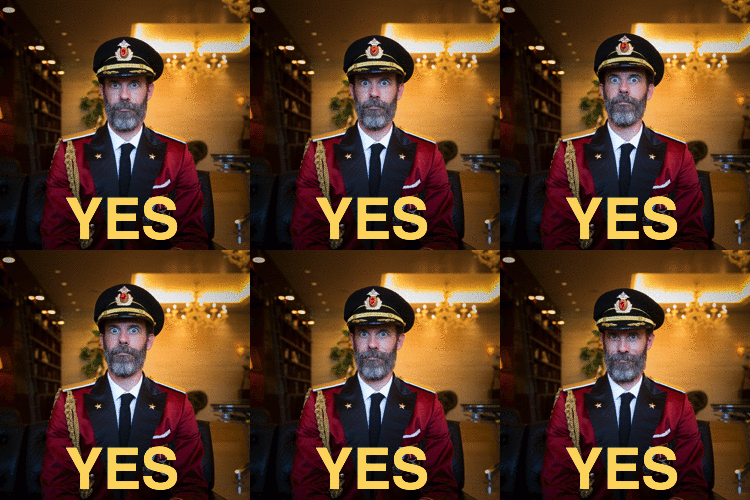
Yes Men

     .

One of the great problems facing people in power is the propensity to surround themselves with “yes men.” Once you have money or power, it is human nature to seek adulation and reinforcement rather than criticism.

This is not unusual, it tends to be the norm. I recall my father, a dairy farmer, meeting the Commissioner of Agriculture for New York State during the Rockefeller administration. My Dad asked him a general question of what his job was like. His response in a rather off-handed manner was: “Well my real job is to do what I can to get the Governor re-elected.” It was an accurate reflection, I expect, but not what my father, a farmer, was expecting to hear.

I never forgot that story. People in power tend to put around them people who will agree with them and under any circumstances will support them. Though I know that this will upset some readers, this is what I believe to be a real weakness in our current President and his administration. If you are soft-spoken yet strong, let’s say like General Mattis, you won’t be long in your job. Better to be a vocal supporter and obliging… more like Secretary of State Pompeo. When the history books are written about the Trump administration, a lot of it will probably be about the “yes men” who got it wrong.

When the history books are written about the Trump administration, a lot of it will probably be about the “yes men” who got it wrong.

Lest I be criticized of being totally partisan, I would assert that the same kind of problem is what has sometimes gotten our own Governor into trouble. Some of the people closest to him who were responsible for his Upstate economic development programs are now going to jail. They wanted to please the Governor and execute his policies even if that meant stepping outside the law. It would have been better if they had stood up and said “No” more often.

The “yes man” problem is not only the province of government and politics. It happens also in business. Recently a car company executive is purported to have used company funds to throw his own opulent wedding party at a chateau near Versailles. Where were the advisors who should have said “No?”

Are there examples of doing it differently? The answer is “Yes,” you don’t always have to have “yes men” around you.

Two examples in politics come to mind. Doris Kearns Goodwin wrote a book about Lincoln titled “Team of Rivals.” President Lincoln intentionally appointed people to his cabinet who disagreed with him and didn’t like each other. One was a politician who had run against him and who had a history here in Chautauqua County as a real estate mogul with the Holland Land Company, William Seward. Lincoln made Seward Secretary of State, and he ended being one of the Presidents best advisors on politics and foreign affairs. He also maintained his interest in real estate and ultimately engineered the purchase of Alaska from Russia for a pittance.

Another President known for appointing those who opposed him was Franklin Roosevelt. After Frank Knox ran as the Republican Vice Presidential candidate in 1936, Roosevelt named him Secretary of the Navy. After defeating Wendell Willkie, a Republican, in the political campaign for President in 1940, Roosevelt appointed him as a personal overseas envoy during World War II.

In other words, strong and successful Presidents (or business executives) are not afraid of criticism, opposition or differences of opinion. They are inquisitive and welcome it. That is the way they find out what the truth is. Speaking truth to power is important.


Rolland Kidder
This commentary originally appeared in The Post-Journal on February 17, 2019.


Monday, January 21, 2019

Thoughts on Wall Building


It wasn’t too long ago that President Reagan in a speech in Berlin exhorted the leader of the Soviet Union to “tear down this Wall!”  Now we are talking about building one of our own along the entire Mexican border.

I must admit early on that I am not much of a fancier for walls resolving anything. If they are built permanently and “real big,” then they might someday become a tourist attraction — like the Great Wall of China. But, even in its day, the Great Wall didn’t help much to stop the eventual destruction of the Ming Dynasty. It wasn’t the threat of Mongol hordes overrunning China as much as the internal rot of the entrenched dynasties themselves that precipitated their failure.

If anything, walls give you a false sense of security. Fences may keep the “riff-raff” out of your backyard for a while, but eventually, without neighborliness prevailing, the neighborhood will fall apart. Fencing someone out means that you are also fencing yourself in.

Fencing someone out means that you are also fencing yourself in.

For centuries, hard borders around the nations of Europe kept national identities homogeneous; but they also guaranteed a lot of wars. People were never satisfied as to where the fences should be and so the solution was to go to war in order to expand your backyard. Frankly, I have been heartened by the development of the European Common Market, the Euro and the establishment of a European federal union of sorts. It hasn’t been perfect, but it has expanded the concept of what is the “common good” in an area of the world which has had a long history of war.

Another experience of my own makes me suspicious of walls. I am a veteran of the Vietnam War and at the end of that whole sad episode, people found a way to escape — primarily by small boats. If we totally blocked land access from Canada and Mexico with border walls, wouldn’t it be reasonable to expect that our shores could then become subject to “boat people” arriving to become U.S. citizens? Then would we have to build fences all along our coasts in order to keep ourselves safe? Border walls in front of beach condos? I don’t think so, but where would it stop?

At the end of the day, philosophically, I just don’t like fences or walls. They may be needed to contain livestock or even pets and required to imprison convicted felons. But, for human beings in general, I think they are a surrender to fear and insecurity. If people enter our country illegally, they should be prosecuted or dealt with under the law. But walls every place? Not for me. In America, it is the very idea of our being a free and law-abiding people which should be our best defense. I have heard enough of walls.


Rolland Kidder 
This article first appeared in The Post-Journal on Jan 20, 2019


Saturday, November 24, 2018

A view of the U.S. Elections from Scotland

Since we were going to Scotland to visit friends, we voted absentee this year on election day. That also meant that we viewed the U.S. elections from abroad which was interesting in itself.

BEAUTIFUL SCOTLAND - A FILM BY JOHN DUNCAN

Our Scottish friends are Conservatives (Tories,) and so each day we would read The Daily Telegraph to get our news. (The Telegraph is a long-standing, well-known, conservative-oriented newspaper in the United Kingdom (U.K.) and is referred to by our friends as “The Torygraph.”)  On the Thursday following the U.S. elections the headlines in The Telegraph read: “America stays divided after the midterm elections” with a sub-headline stating “President is stronger than you might think.”  Both, I thought accurately reflected what was going on in our national politics back home.

Unfortunately, at about this same time, President Trump was getting negative headlines in the U.K. and throughout Europe because of his confrontation with President Macron of France. The President was in France to represent the United States at ceremonies commemorating the 100th Anniversary of the end of World War I. It was to be an uplifting moment to gather with our allies and remember the thousands of soldiers who gave their lives in that conflict. (About a third of our war dead from World War I are still buried in American cemeteries on French soil.)

On the 11th hour, of the 11th day, of the 11th month, 2018, church services and ceremonies across Europe marked the end of that horrific war.  However, the message of American sacrifice made in bringing it to an end became subsumed in personal controversy because the President “tweeted” his disgust with Macron and then cancelled a scheduled trip to an American World War I cemetery.  

All of this is to say that America continues to be widely covered in the European press and what our President does (or says) is a big part of that.  There is also some yearning in the U.K. that the political “glue” that holds the United States together is needed right now in Europe.  The current government headed by Prime Minister Theresa May could fall because what she is proposing for “Brexit” is splitting her own Conservative Party, and people are realizing that the past 70 years of relative peace and cooperation in Europe is not something that can be taken for granted. 

So where do the British think American politics are going in the future?  One of the articles mentioned above ended with this analysis: 
“Demography is destiny and there’s no escaping the sense that Trump speaks for those who are essentially trying to preserve a way of life—rather than the younger, more culturally liberal Americans who are trying to build a new one.”
Though a bit broad-brushed, I thought that this statement pretty well summed up where we are politically in America.  It also describes the rural part of the country where I live and vote.  The more things change in the country—the more they seem to remain the same around here.


Honoring Robert the Bruce, King of Scots at Bannochburn, Scotland


Rolland Kidder
Stow, NY


Wednesday, October 31, 2018

On Being a Patriot

David Brooks, a conservative columnist in the William Buckley tradition who writes in the New York Times, recently wrote an article where he compared his loyalty to his community and State to that he has for the Nation. He concluded:

“I have to say my strongest attachment is to the nation, to the United States. You could take New York out of my identity and I’d be sort of the same. If you took America out of my identity I’d be unrecognizable to myself.”

That hit me as being absolutely true for myself. I don’t fly a New York State or Chautauqua County flag from our flagpole—I fly Old Glory, the American flag. I don’t feel especially patriotic when the County’s helicopter flies down the lake, but my heart starts beating faster when I see Chinook Army helicopters come roaring over flying in formation with their blades pounding the air. They remind me of my days in Vietnam during the war. They remind me that I am an American.

I must admit that it aggravates me a bit when people equate patriotism with a particular political point-of-view. I believe that Democrats are as patriotic as Republicans, that Conservatives are as patriotic as Liberals. We may disagree on political issues of the day, but that doesn’t tarnish or diminish our being Americans. When I fought together with men in Vietnam, we didn’t base our trust in each other on party affiliation.


I grew up around here and, as most of us who lived on farms, was raised as a Republican. I was still a Republican when I was offered a job working for the Democratic State Central Committee of Indiana in 1966. I wanted to observe “politics in action,” and that job certainly gave me a cat-bird seat to observe it. It ended up being a big Republican year in Indiana, but I clearly remember one meeting I attended where the idea of “patriotism” made a big impact on me.

It was a meeting near Evansville, Indiana of the Posey County Democratic Committee. The Democratic candidate for Indiana Secretary of State I was assisting had gone there to make a speech. However, before he spoke, a member of the County Committee read a portion of scripture from the Bible, the Chairman prayed, then we saluted the flag, recited the Pledge of Allegiance and sang the “Star Spangled Banner.”

It was an over-powering experience. Here, in the heat of a political campaign, people were affirming who they were as Americans. I knew then, if I had never realized it before, that patriotism is not captive to any particular political party… it is a belief in who we are as a country. It goes way beyond party loyalties.

I don’t like it when demonstrators burn the flag. But I know, deep-down, that their right to do so is engrained in what it means to be an American.

Yes, I get upset when people kneel during the national anthem. I don’t like it when demonstrators burn the flag. But, I know, deep-down, that their right to do so is engrained in what it means to be an American.

I love this country. It is the country of all of us. Perhaps the words of the Great Seal of the United States say it best: E Pluribus Unum — “Out of many, one.”


Rolland Kidder
Stow, NY


Wednesday, October 25, 2017

Voting ‘Yes’ On A Constitutional Convention


This commentary originally appeared in the The Post Journal on Oct 15, 2017


From all of the press reports and lawn signs I have been seeing, I may be the only person in Chautauqua County voting in favor of having a Constitutional Convention.


The leaders of both the Democratic and Republican majorities in the state legislature are against it. The Governor is quietly opposed (or seems to be.) The public employee unions are opposed. Most of the lobbyists in Albany are opposed.

Upstate thinks it will be over-powered by downstate. Downstate worries that Upstate will try and secede from the State. Environmentalists are opposed because they think that bad things could happen. Business interests are worried that environmentalists will cause havoc and shut down industry.

In my view, the organized voice to vote “No” on having a Constitutional Convention by most of the entrenched interests in Albany… is probably a good reason to vote “Yes.” A “No” vote is essentially a vote to keep doing business the same old way. The kind of structural reforms that are needed to address the dysfunction and bad habits of state government will not be addressed by those who would be affected by them. The only way that citizens of the State can be assured that reforms will be made is by voting to amend the Constitution.

The vote coming up in November is just the beginning of a process. If approved by voters, a Constitutional Convention would be convened in 2018. Any recommended changes by such a Convention are required to be submitted to the voters in 2019 for approval. The Convention itself does not have the power to amend the Constitution.

In my view, Constitutional changes are the only way to address the governance problems in Albany. For example, do you think that the Governor would ever support limiting the terms of his/her service to 2 terms (8 years) similar to our Federal Constitution? Do you think that the Speaker of the Assembly or Majority Leader of the State Senate would ever propose limiting their tenure as leader to 10 years, as has been done in some other states?

The problems (and criminal indictments) that come from keeping the same people at the top jobs in perpetuity in Albany can only be changed if voters change the State’s Constitution.

I am not surprised that the entrenched interests in Albany want to stay “entrenched” and want you to vote “No” on the November 7th ballot.

Though it may be futile in a low turnout election as predicted for this year and defeat seems likely … I am still going to cast a “Yes” vote to have a Constitutional Convention. The only way we are going to clean up Albany is to put limits on the current power structure. Hoping that the legislature and Governor will solve this problem is not a solution. They will never vote to limit their power and authority. I know, I was there once.


Rolland Kidder

Rolland Kidder is a Stow resident and former member of the New York state Assembly.


Wednesday, October 4, 2017

A Third Party?

This commentary originally appeared in the The Post-Journal on Oct 1, 2017

There has been more talk recently about a third political party emerging out of the chaos we see going on in Washington. A lot of people, whom I would call “common sense” Republicans and Democrats, have been talking about it. Why shouldn’t they?

For example, for some Republicans it gets tiresome to have to try and defend a plan to spend billions on a new wall along the U.S./Mexican border. They still remember President Ronald Reagan’s “tear down this Wall” speech which he made in Berlin in 1987.

On a totally different issue, many Democrats cringe when they turn on their natural gas furnace in the winter because the official “line” of their party keeps putting up obstacles to natural gas development. In places like New York State its production has essentially been banned and it is next to impossible to build a natural gas pipeline.

What is going on here is that in the Republican Party, the right wing is calling the shots on foreign policy: “Build the Wall!” On the other hand, in the Democratic Party the left wing is calling the shots on energy policy: “Ban all fossil fuels!” Most middle-of-the road Americans see things exactly the opposite. They “Oppose the wall!” and “Support natural gas!”…maybe these “middle Americans” should organize themselves into a new political party that more realistically represents their views.

"If there were such a political party, I might join it"

If there were such a political party, I might join it. The Democratic position on energy (and especially natural gas) is totally disingenuous. Natural gas is the cleanest and most cost effective way to heat a house. The new ways of drilling and completing natural gas wells are environmentally safer than the old ways, natural gas is produced domestically (not dependent on the Middle East) and the energy is needed to back up and provide firm service for the new, but interruptible, forms of energy like solar and wind. Being against natural gas? How could the Democratic Party be so wrong on such a common sense issue?

In a similar way, the Republican right-wing position on building a Mexican wall is equally as crazy. Don’t people understand that airplanes fly over walls? Afghanistan has always been one of the prime sources of opiate production. Our military now essentially controls the country. Has anyone been suggesting that we build a wall around Afghanistan to stop illegal drug exports to the U.S.? In the end, the Great Wall of China failed to keep out the Mongols, but at least it was an architectural marvel which became a tourist attraction. Building “walls” doesn’t answer anything.

So, if I am opposed to wall building as a basis for foreign policy and support natural gas development as an energy policy… maybe I should be looking for a new political party. Maybe it could be called the “Americans United Party.” It would try to solve common problems by people pulling together on the same oar. (Think of national unity during World War II.)

Of course, pragmatically, it is next to impossible to form a new political party. (Remember Ross Perot?) All the states have Boards of Elections essentially controlled by the Republican and Democratic parties. So I am not sure how it could be done. Yet, I do believe there is growing public support for a return to common sense politics which address the primary concerns of voters and are not dominated by the views of fringe groups which now drive the policies of the existing major political parties.


Rolland Kidder, 
Stow, NY


Monday, September 25, 2017

The New Politics of Washington

This commentary originally appeared in the The Post-Journal on Sep 24, 2017


Whether you like Donald Trump or don’t, it seems apparent now that he is operating on a different wave-length at least when it comes to partisan politics. On paper, his party controls both houses of the federal legislature, yet he recently signed off on a deal to keep government running with Democratic support. What gives?

President Trump is essentially a transactional person.   He is not much driven by ideology.

In my opinion, President Trump is essentially a transactional person. He is not much driven by ideology. He wants to do things, and he also wants to be at the center of whatever that is. If “X” doesn’t work, he will try “Y.”

If casinos in New Jersey no longer work, let’s try building hotels overseas. If the Republicans on Capitol Hill can’t deliver on a vote (like repealing Obamacare,) then let’s see what the Democrats have to offer.

In a counter-intuitive kind of way, maybe we are finding a way forward for this Presidency. The White House will make a proposal today, and a “tweet” might reverse it tomorrow. Yet, if what ultimately gets done, requires the consent of both major political parties on Capitol Hill… maybe the country can move forward.

What is clear is that President Trump is beginning to realize that running the Executive branch of the federal government is a lot different from running a multi-million dollar private corporation. You can’t just lay down an edict which everyone will agree to. You have to find consensus which means compromise and vote-counting.

Some Democrats may find fault with Senate Minority Leader Chuck Schumer for his willingness to deal with this President. Yet, I find it laudable that our Senator is able to put aside some basic disagreements and try to find common ground upon which to run the government.

Even a person who doesn’t like government still doesn’t want it shut down. People want their social security checks, their healthcare, and definitely want a strong military protecting them.

Where is all of this going? It is still too early to tell but I think it is fair to say that our current President does not want the government to shut down on his watch.

Those of us who are essentially “observers” in all of this watch in amazement. Congressional investigations continue to go on, changes keep happening at the White House, sometimes it is hard to know who is on first, second or third base. Nevertheless, it is not boring.

One other “unknown” has, in my opinion, become a stabilizing force in our politics… and that is the impact of Hurricanes Harvey and now Irma.

In a “backdoor” kind of way, these tragic weather events have become a common experience in unifying the country. We all need each other and want to help each other.

Keeping the government running never seemed to be a priority, it was a given. It is clear that it is not something we can take for granted any longer; and, for now, it has become the catalyst for action on Capitol Hill. 


Rolland Kidder

Rolland Kidder is a Stow resident.