Sunday, March 24, 2019

Thinking Outside the Box


NYS DEC ALGAL BLOOM ACTION PLAN

I was intrigued recently to hear County officials talking about another community in New York state which might be a model for addressing the issues surrounding Chautauqua Lake. This is the Lamoka-Waneta Lake area in the southern Finger Lakes. 

Around fifteen years ago, an old friend, John Sember (now deceased,) invited representatives from this area to the Jackson Center for what he called a “Pearl City Lyceum.” John thought that they might have insight into dealing with lake weeds which had been choking their lakes. Now, over a decade later, they have proven to have “staying power,” have in place a DEC approved program, and have established a working Association which is supported by property owners for applying herbicides and taking other actions to keep their lakes clean while protecting fishing and other lake interests.

One of the problems in Chautauqua County is that we tend to think “the wheel was invented here.”

One of the problems in dealing with local issues in Chautauqua County is that we tend to think that “the wheel was invented here,” that just because we have been doing things one way…that is the only way that they can be done, i.e. our lakes have only been managed one way, our schools have always been structured in a certain way, our municipalities have always been here doing what they do, the one way they always do it. Result: we get frozen in time and nothing changes.

In a totally different and larger context, I was speaking with someone recently about how our American governmental system compares with other democratic governments. As patriotic Americans we always think our system is the best system.

Yet, in the aftermath of World War II, Americans looked “outside-the-box” when we helped frame what the governments would be for our defeated enemies–Germany and Japan. In so doing, we looked at various models and didn’t exactly replicate what our own form of government was. In both instances, we helped establish parliamentary forms of government where the leader or Chief Executive would come from the legislative branch of government.

These two nations have, as we do, an independent judiciary, but their executive branch leader, the Prime Minister, comes from roots in their legislative system. I would expect that this approach was taken, in part, because of an American concern in avoiding a system where another Hitler or Hirohito could come out of nowhere and take these countries over.

By having the Prime Minister come out of the government it means that she/he has at least been vetted by peers as having the qualities and capabilities for responsible leadership. You can’t just come out of nowhere with a lot of money and become the Chief Executive of Germany or Japan.

Though the U.S. model of the independent election of a President was not used in rebuilding Germany or Japan–you can’t argue with success. They have become our two strongest democratic allies in Asia and Europe. Sometimes using a model other than “same-old, same-old” can be good.

There are many communities out there who have very similar problems to our own, we should learn from how others have dealt with these issues.

So, when we are looking on ways to make our county or community better, I am all for looking “outside-the-box,” for other models. There are probably communities out there who have similar problems to our own. Whether it is our lake, our school districts or our municipalities–we should be taking a look at how others have dealt with the issues we are now facing.


Rolland Kidder
This commentary appeared in The Post-Journal on March 24


Monday, February 18, 2019

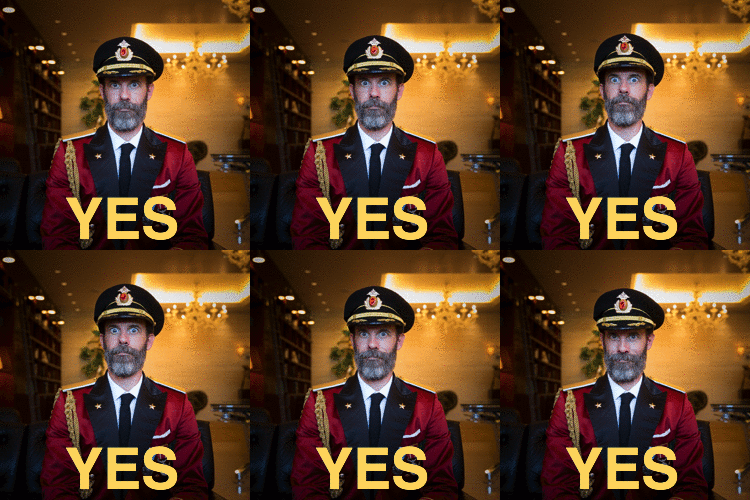
Yes Men

     .

One of the great problems facing people in power is the propensity to surround themselves with “yes men.” Once you have money or power, it is human nature to seek adulation and reinforcement rather than criticism.

This is not unusual, it tends to be the norm. I recall my father, a dairy farmer, meeting the Commissioner of Agriculture for New York State during the Rockefeller administration. My Dad asked him a general question of what his job was like. His response in a rather off-handed manner was: “Well my real job is to do what I can to get the Governor re-elected.” It was an accurate reflection, I expect, but not what my father, a farmer, was expecting to hear.

I never forgot that story. People in power tend to put around them people who will agree with them and under any circumstances will support them. Though I know that this will upset some readers, this is what I believe to be a real weakness in our current President and his administration. If you are soft-spoken yet strong, let’s say like General Mattis, you won’t be long in your job. Better to be a vocal supporter and obliging… more like Secretary of State Pompeo. When the history books are written about the Trump administration, a lot of it will probably be about the “yes men” who got it wrong.

When the history books are written about the Trump administration, a lot of it will probably be about the “yes men” who got it wrong.

Lest I be criticized of being totally partisan, I would assert that the same kind of problem is what has sometimes gotten our own Governor into trouble. Some of the people closest to him who were responsible for his Upstate economic development programs are now going to jail. They wanted to please the Governor and execute his policies even if that meant stepping outside the law. It would have been better if they had stood up and said “No” more often.

The “yes man” problem is not only the province of government and politics. It happens also in business. Recently a car company executive is purported to have used company funds to throw his own opulent wedding party at a chateau near Versailles. Where were the advisors who should have said “No?”

Are there examples of doing it differently? The answer is “Yes,” you don’t always have to have “yes men” around you.

Two examples in politics come to mind. Doris Kearns Goodwin wrote a book about Lincoln titled “Team of Rivals.” President Lincoln intentionally appointed people to his cabinet who disagreed with him and didn’t like each other. One was a politician who had run against him and who had a history here in Chautauqua County as a real estate mogul with the Holland Land Company, William Seward. Lincoln made Seward Secretary of State, and he ended being one of the Presidents best advisors on politics and foreign affairs. He also maintained his interest in real estate and ultimately engineered the purchase of Alaska from Russia for a pittance.

Another President known for appointing those who opposed him was Franklin Roosevelt. After Frank Knox ran as the Republican Vice Presidential candidate in 1936, Roosevelt named him Secretary of the Navy. After defeating Wendell Willkie, a Republican, in the political campaign for President in 1940, Roosevelt appointed him as a personal overseas envoy during World War II.

In other words, strong and successful Presidents (or business executives) are not afraid of criticism, opposition or differences of opinion. They are inquisitive and welcome it. That is the way they find out what the truth is. Speaking truth to power is important.


Rolland Kidder
This commentary originally appeared in The Post-Journal on February 17, 2019.


Saturday, February 2, 2019

A Special Breed of Fishermen


It is that time of year again when the ice fishermen dominate the landscape of Chautauqua Lake. (My definition of these individuals also includes women who fish through the ice.)

Many of them are the same as those who fish by boat in the summertime but, in my view, ice fishermen are in many ways a special breed. Some of what they do is about catching fish, but a lot of what they do is about tangling with the elements and the ice.

They sit by themselves, with their back facing the wind - the way cows do in a summer rainstorm.

There are a few loners who come with their five-gallon bucket which is used as a seat, a container to carry equipment, and a grocery bag to carry fish home if they get lucky. They sit by themselves, with their back facing the wind—the way cows do in a rainstorm in the summer. They might say “hi” to a passing fisherman but they don’t divulge their deep secrets of what they are catching or how.

However, most ice fishermen come in two’s, three’s or four’s. They don’t seem to talk a lot but there is mutual reinforcement when you can bounce off your buddy the depth at which you got a bite or what lure might be working best. Or, if you are fishing with one of your kids, then there is the satisfaction of knowing that you are passing on something of life-long value. Elemental and simple conversation is best on the ice. It is probably not a place to talk much about religion or politics.

Unlike fishing in the summer, there is no boat noise or boom boxes with music blaring from a ski boat. There is just the sky, the wind and the ice. It is quiet and awe-inspiring for the most part. As the ice gets thicker, a snow mobile or two may come down the lake. But, they are usually just passing through and not serious intruders.

I have noticed a few changes over the years. There are more multi-colored pop-up tents to block the wind out on the ice. There are also changes wrought by electronic fish-finders. An ice fisherman newly arrived may wander around a bit looking for fish beneath the surface with his device. However, if he is here for a second day, he may well walk in a straight line to the exact place he was fishing the day prior where he had already found fish. There is probably a good chance the fish are still there.

There are a couple of unchanging things about ice fishing. If numbers of fishermen mean anything, dusk still seems the preferred time to fish. A spouse waiting at home may have to delay dinner until after the sun goes down and her fisherman gets off the lake.

And then there is the walleye—still the tastiest and most preferred fish to catch. There is nothing like the savory taste of fresh walleye taken from the lake, and the good news is that there are still plenty of them being caught.

A cold, clear day turning to night with an almost limitless horizon of sky while catching a walleye through a hole in the ice that you have cut yourself…how does it get any better than that?


Rolland Kidder
Stow, New York


unsplash-logoCarlos Santos

Monday, January 21, 2019

Thoughts on Wall Building


It wasn’t too long ago that President Reagan in a speech in Berlin exhorted the leader of the Soviet Union to “tear down this Wall!”  Now we are talking about building one of our own along the entire Mexican border.

I must admit early on that I am not much of a fancier for walls resolving anything. If they are built permanently and “real big,” then they might someday become a tourist attraction — like the Great Wall of China. But, even in its day, the Great Wall didn’t help much to stop the eventual destruction of the Ming Dynasty. It wasn’t the threat of Mongol hordes overrunning China as much as the internal rot of the entrenched dynasties themselves that precipitated their failure.

If anything, walls give you a false sense of security. Fences may keep the “riff-raff” out of your backyard for a while, but eventually, without neighborliness prevailing, the neighborhood will fall apart. Fencing someone out means that you are also fencing yourself in.

Fencing someone out means that you are also fencing yourself in.

For centuries, hard borders around the nations of Europe kept national identities homogeneous; but they also guaranteed a lot of wars. People were never satisfied as to where the fences should be and so the solution was to go to war in order to expand your backyard. Frankly, I have been heartened by the development of the European Common Market, the Euro and the establishment of a European federal union of sorts. It hasn’t been perfect, but it has expanded the concept of what is the “common good” in an area of the world which has had a long history of war.

Another experience of my own makes me suspicious of walls. I am a veteran of the Vietnam War and at the end of that whole sad episode, people found a way to escape — primarily by small boats. If we totally blocked land access from Canada and Mexico with border walls, wouldn’t it be reasonable to expect that our shores could then become subject to “boat people” arriving to become U.S. citizens? Then would we have to build fences all along our coasts in order to keep ourselves safe? Border walls in front of beach condos? I don’t think so, but where would it stop?

At the end of the day, philosophically, I just don’t like fences or walls. They may be needed to contain livestock or even pets and required to imprison convicted felons. But, for human beings in general, I think they are a surrender to fear and insecurity. If people enter our country illegally, they should be prosecuted or dealt with under the law. But walls every place? Not for me. In America, it is the very idea of our being a free and law-abiding people which should be our best defense. I have heard enough of walls.


Rolland Kidder 
This article first appeared in The Post-Journal on Jan 20, 2019


Sunday, January 6, 2019

How Do We Save Rural America?


There was a recent article in the New York Times by Eduardo Porter addressing the “hard truths” of what is happening in rural America. It was compelling in the sense that it brought home the story of what I see happening here in Chautauqua County.

Some of the facts it stated were worrisome:
  • Rural America is getting old. The median age is 43, seven years older than city dwellers.
  • Since the 2008 recession, counties with less than 100,000 people lost 17,500 businesses whereas Counties with more that 1 million gained 99,000 new firms. 
  • Manufacturing remains the strongest sector in rural America, but today there are fewer than “13 million workers in manufacturing across the entire economy.”
  • In the “Eastern Heartland,” that area “roughly between the Mississippi River and the Atlantic coast, rural communities are doing particularly poorly.”
  • We are experiencing “agglomeration” throughout the economy: “Innovative companies choose to locate where other successful, innovative companies are. That’s where they can find lots of highly skilled workers. The more densely packed these pools of talent are, the more workers can learn from each other and the more productive they become.”

A light went off when I thought about “agglomeration.” Why would Amazon choose two new headquarters right in the heart of New York City and in the Washington, D.C. metro area? These places are already over-populated with jammed highways and high costs of living. Answer: agglomeration! They want high-powered, concentrated pooled talent in one place. Rural America was never a consideration in Amazon’s decision. Even medium sized cities like Columbus, Ohio had no chance in this competition. Now, Google has announced that they are also ramping up employment in these same areas, and Apple is opening another headquarters in Austin, Texas which is already a tech center.

So, in light of these economic facts, what do we do in rural America? Is there a way for us to get some of our young people to return home? Is there a plan to rejuvenate rural America? As the article warns: “What if nothing really works?… Do we “return depopulated parts of rural America to the bison?”

The article concluded with these words: “The distress of 50 million Americans should concern everyone. Powerful economic forces are arrayed against rural America and, so far, efforts to turn it around have failed. Not every small town can be a tech hub, nor should it be. But, that can’t be the only answer.”

Rolland Kidder 
This article first appeared in The Post-Journal on Jan 6, 2019


unsplash-logospecphotops

Sunday, December 16, 2018

It’s Not All Bad Here In Western New York

There was recently sad business news when the New Era Hat Company announced that it was closing its manufacturing plant in Derby. Yet, the very next day, there were comments from other manufacturers in the Buffalo area indicating that they had potential job openings for those workers who were losing their jobs.

I was especially encouraged that one of those comments came from a young man I know who grew up here and now owns a manufacturing business in Buffalo. It shows you that there can be a future in Western New York for our young people. They might not always come back to Chautauqua County, but they could be close by in Erie County.


When you look at the nation at large, Buffalo is really a small town. Yet, Buffalo and the Western New York area as a whole support an NFL and an NHL team, have a large research University, a very diverse population, and remain a good place for manufacturing. When you add to that the relative low cost of living and housing, and fewer traveling headaches than if you lived in a Chicago or New York–it can be a magnet for getting some of our kids to come home and live here.

I don’t think that Western New York will ever suffer from the urban sprawl of a Los Angeles or Chicago, but that is one of its strengths. Yes, the winters can be bad and you might not be able to command as big a salary as in Silicon Valley. But, in terms of livability and establishing a home…it is a pretty good place to be.

There is another real plus and that is the cost of education. Many of my friends’ grown children live in large urban areas and spend a lot of money sending their kids to private schools. Around here, you can find very good K-12 public schools. Yes, we have too many school districts and school taxes are high. Yet, you get something for it. You can graduate from a public school in Western New York and be accepted into the finest universities in the country. That is a good thing.

We have our problems. We have poverty and sometimes our infrastructure gets old and out-of-date. Because we are an older area of the country and a bit off the “beaten path,” we have not experienced a lot of growth and so we have to fix up the old as we build the new.

If global warming is a worry, remember that we live on high ground and the water all goes downhill from here!

Yet, the bottom line is that there are reasons to be optimistic about where we live. When you read about the fires in California and the hurricanes in Florida, maybe living through a few snow storms in Western New York is really not at all that bad. Also, if global warming is a worry, remember that we live on high ground and the water all goes downhill from here! It is probably my age, but the longer I live in this region of the country–the better I like it.

Rolland Kidder 
This article first appeared in The Post-Journal on December 16, 2018


End of an Era in the N.Y. State Legislature


New York State Capitol Building, Albany NY


When I was a member of the State Assembly (1975-’82,) I served with long-time State Senator from Bemus Point, Jess Present. What I quickly found out is that, in Albany, being in the majority party in the legislature makes a huge difference.

Since Jess (a Republican) was in the majority in the State Senate and I was (a Democrat) in the majority in the Assembly–we could get a lot of legislation passed. Being in the majority also meant that we had significant input into the annual state budget, including funding of items important to our districts in the Southern Tier. Despite our political differences, Jess and I maintained a strong personal friendship.

Until now, the Southern Tier West counties of Chautauqua, Cattaraugus and Allegany have nearly always had at least one representative in the legislature in the majority party. For most of our recent history, Senator Cathy Young has been that person. That meant we had a meaningful say in the state budget and in legislation coming from Albany.

However, the situation in the state legislature significantly changed on the evening of November 6, 2018. Though Senator Young is well-liked and easily won re-election here, the Republicans lost the State Senate majority… and they lost it big. The Republicans went from having 31 State Senators to now having 23. Had the loss been less severe, they could have retained some hope of retaking the majority in 2020. However, in my view, because of the immensity of their loss… they will probably not regain the majority in the State Senate, especially since there will be reapportionment after the 2020 census.

In a state where Democrats outnumber Republicans by two to one, the Assembly already has a Democratic super-majority and the state Senate is now close to that. That means that New York will slide into the category of states like Massachusetts and California where the Republican Party has generally become noncompetitive on the state level and is now the permanent minority party.

If one were to base the election of 2018 on results from Chautauqua County, it would have been a banner year for Republicans. Not only did we overwhelmingly re-elect our Republican Assemblyman, State Senator and Congressman — the GOP candidate for Sheriff was also elected and now Republicans hold all county-wide offices (except for DA) and have a commanding majority in the county legislature.

Though the GOP remains strong around here, it has almost become irrelevant in some of the more urban areas of the state.

However, New York is a very diverse state and the further east you went this year, the weaker the Republican Party became. On Long Island, which was represented by seven Republican state Senators–after November 6 there were only three left. Though the GOP remains strong around here, it has almost become irrelevant in some of the more urban areas of the state. It also seemed rather odd to me that the remaining Republican state Senators chose John Flanagan of Long Island, whose party was crushed in the suburbs around New York, for minority leader over Cathy Young from Upstate where the GOP did quite well and still maintains a strong political base.

Of course, our concern out here in the “forgotten corner” of New York, is how do we now retain effective representation in Albany when both our Assemblyman and State Senator are in the minority and will likely remain so? It won’t be easy. Yet, it is something very real and a matter to which we should pay attention. A new era in the state Legislature has begun.

Rolland Kidder
This article first appeared in The Post-Journal on December 12, 2018


Saturday, November 24, 2018

A view of the U.S. Elections from Scotland

Since we were going to Scotland to visit friends, we voted absentee this year on election day. That also meant that we viewed the U.S. elections from abroad which was interesting in itself.

BEAUTIFUL SCOTLAND - A FILM BY JOHN DUNCAN

Our Scottish friends are Conservatives (Tories,) and so each day we would read The Daily Telegraph to get our news. (The Telegraph is a long-standing, well-known, conservative-oriented newspaper in the United Kingdom (U.K.) and is referred to by our friends as “The Torygraph.”)  On the Thursday following the U.S. elections the headlines in The Telegraph read: “America stays divided after the midterm elections” with a sub-headline stating “President is stronger than you might think.”  Both, I thought accurately reflected what was going on in our national politics back home.

Unfortunately, at about this same time, President Trump was getting negative headlines in the U.K. and throughout Europe because of his confrontation with President Macron of France. The President was in France to represent the United States at ceremonies commemorating the 100th Anniversary of the end of World War I. It was to be an uplifting moment to gather with our allies and remember the thousands of soldiers who gave their lives in that conflict. (About a third of our war dead from World War I are still buried in American cemeteries on French soil.)

On the 11th hour, of the 11th day, of the 11th month, 2018, church services and ceremonies across Europe marked the end of that horrific war.  However, the message of American sacrifice made in bringing it to an end became subsumed in personal controversy because the President “tweeted” his disgust with Macron and then cancelled a scheduled trip to an American World War I cemetery.  

All of this is to say that America continues to be widely covered in the European press and what our President does (or says) is a big part of that.  There is also some yearning in the U.K. that the political “glue” that holds the United States together is needed right now in Europe.  The current government headed by Prime Minister Theresa May could fall because what she is proposing for “Brexit” is splitting her own Conservative Party, and people are realizing that the past 70 years of relative peace and cooperation in Europe is not something that can be taken for granted. 

So where do the British think American politics are going in the future?  One of the articles mentioned above ended with this analysis: 
“Demography is destiny and there’s no escaping the sense that Trump speaks for those who are essentially trying to preserve a way of life—rather than the younger, more culturally liberal Americans who are trying to build a new one.”
Though a bit broad-brushed, I thought that this statement pretty well summed up where we are politically in America.  It also describes the rural part of the country where I live and vote.  The more things change in the country—the more they seem to remain the same around here.


Honoring Robert the Bruce, King of Scots at Bannochburn, Scotland


Rolland Kidder
Stow, NY


Wednesday, October 31, 2018

On Being a Patriot

David Brooks, a conservative columnist in the William Buckley tradition who writes in the New York Times, recently wrote an article where he compared his loyalty to his community and State to that he has for the Nation. He concluded:

“I have to say my strongest attachment is to the nation, to the United States. You could take New York out of my identity and I’d be sort of the same. If you took America out of my identity I’d be unrecognizable to myself.”

That hit me as being absolutely true for myself. I don’t fly a New York State or Chautauqua County flag from our flagpole—I fly Old Glory, the American flag. I don’t feel especially patriotic when the County’s helicopter flies down the lake, but my heart starts beating faster when I see Chinook Army helicopters come roaring over flying in formation with their blades pounding the air. They remind me of my days in Vietnam during the war. They remind me that I am an American.

I must admit that it aggravates me a bit when people equate patriotism with a particular political point-of-view. I believe that Democrats are as patriotic as Republicans, that Conservatives are as patriotic as Liberals. We may disagree on political issues of the day, but that doesn’t tarnish or diminish our being Americans. When I fought together with men in Vietnam, we didn’t base our trust in each other on party affiliation.


I grew up around here and, as most of us who lived on farms, was raised as a Republican. I was still a Republican when I was offered a job working for the Democratic State Central Committee of Indiana in 1966. I wanted to observe “politics in action,” and that job certainly gave me a cat-bird seat to observe it. It ended up being a big Republican year in Indiana, but I clearly remember one meeting I attended where the idea of “patriotism” made a big impact on me.

It was a meeting near Evansville, Indiana of the Posey County Democratic Committee. The Democratic candidate for Indiana Secretary of State I was assisting had gone there to make a speech. However, before he spoke, a member of the County Committee read a portion of scripture from the Bible, the Chairman prayed, then we saluted the flag, recited the Pledge of Allegiance and sang the “Star Spangled Banner.”

It was an over-powering experience. Here, in the heat of a political campaign, people were affirming who they were as Americans. I knew then, if I had never realized it before, that patriotism is not captive to any particular political party… it is a belief in who we are as a country. It goes way beyond party loyalties.

I don’t like it when demonstrators burn the flag. But I know, deep-down, that their right to do so is engrained in what it means to be an American.

Yes, I get upset when people kneel during the national anthem. I don’t like it when demonstrators burn the flag. But, I know, deep-down, that their right to do so is engrained in what it means to be an American.

I love this country. It is the country of all of us. Perhaps the words of the Great Seal of the United States say it best: E Pluribus Unum — “Out of many, one.”


Rolland Kidder
Stow, NY


Monday, October 15, 2018

The Divided States of America


The evening of the Kavanaugh hearing, I “surfed” the channels to get the news. All I could find was the hearing or commentary on it. I finally turned off the TV. It made me sick.

The hearing confirmed to me that America is more divided than ever. It was not just his word vs. her word. It was “my guy vs. your guy.” No compromise, no middle ground — just smash mouth football. I decided to tune it out.

No compromise, no middle ground — just smash mouth football.  I decided to tune it out.

It can make you depressed but, in the long view, we have to face the fact that divided politics in America is a large part of our history. Right after a tremendous moment of national unity during the Second World War, the country descended into McCarthyism with conspiracy theorists finding communists in every corner of the government. After our most divisive conflict, the Civil War, the country really didn’t heal as one. It split apart again over the policies of reconstructing the Confederate States. As for my growing-up years, I was a Vietnam Veteran — one of the most contentious and divisive times in our history.

Is today’s division worse? Probably not, but it feels worse because of the magnified impact delivered by our multi-dimensional media, accentuated by tweeting from the White House (which I think should be banned for anyone who becomes President). When you get hammered with something like the Kavanaugh Hearing it comes at you in print, on the screen, on the radio and through your smart phone. It feels like a deluge that will sweep you away.

I honestly don’t think there are any real winners in the kind of spectacle we saw in the Kavanaugh hearing. The accuser comes to the table quite late in the process and questions linger as to her timing in coming forth. The accused, Judge Kavanaugh, responds in an angry diatribe against the system implying that the deck is stacked against him. The last thing he seems to have in his response is judicial temperament. The bewildered country looks on the whole process as a sort of “one-shot” soap opera. 

The losers are many starting with the country as whole.

The losers are many starting with the country as whole. The U.S. Senate no longer looks like one of the great deliberative bodies in the world. The Supreme Court itself is becoming more polarized and losing its credibility as a fair arbiter in the major issues facing the country.

National unity remains an aspiration in our politics, not a reality. If there is any historical perspective to this moment, it does give credence to our long-standing reputation as being the “Divided States of America.” 


Rolland Kidder 
This article first appeared in The Post-Journal on October 14, 2018

Monday, September 24, 2018

Cuomo Wins Decisively

This article first appeared in The Post-Journal on September 23, 2018

You have to give the Governor credit, he won the Democratic Primary in a big way. I thought that with the “Me-Too” movement and the “Progressives”dominating the news that Cynthia Nixon would have run a closer race. It helped that the Governor outspent her by about 8-1 but, that being said, you cannot detract from his very decisive victory.


In the other races, Letitia James was elected as the Democratic candidate for Attorney General and Kathy Hochul was elected to be the candidate for Lieutenant Governor. They won these races despite the fact that they were not endorsed by the New York Times. That, in itself, is an accomplishment. Often, the Times’ endorsement in New York City virtually assures election. However, this time, the voters in New York split their votes. For example, though Kathy Hochul lost in Brooklyn and Manhattan–she carried the day in the Bronx, Queens and Long Island. Not a bad outcome for a person from Buffalo running against a New York City Councilman.

Now, we repivot for the General Election. By most accounts, Andrew Cuomo will be re-elected Governor. The Republican candidate, Marc Molinaro, who is the County Executive of Dutchess County, is a well-liked and articulate person. However, so far, he has been unable to raise significant amounts of money for the race. In a state like New York, it is very expensive to go on television and communicate your message unless you are either rich or can raise money. Unless Andrew Cuomo stumbles badly or an investment “angel” arrives to finance the Molinaro campaign…it is hard to see the Republicans taking back the Governor’s mansion.

We who live upstate and are a minority in the State, will lose a strong, counter-balancing voice in Albany.

What is more concerning to me as an “upstater” is that it is likely this year that the Democrats will win a majority in the State Senate. Once that happens, I doubt that the State Senate will ever return again to Republican hands. Thus, we who live upstate and are a minority in the State, will lose a strong, counter-balancing voice in Albany.

I remember the days when stalwart, mainstream Republicans like Jacob Javits and Louis Lefkowitz could win statewide. Then there was Nelson Rockefeller and later, George Pataki, who found a way to be elected Governor. However, New York is starting to look a lot more like California in its politics. The Republican Party in California is now so marginalized that the State has gone to a system of having the top two “vote-getters” in the Primary run against each other so at least there is a choice in the General Election. Often the top two are Democrats. Could or should New York move in this direction so that voters in the General Election will continue to have a choice?

California has gone to a system of having the top two “vote-getters” in the Primary run against each other so at least there is a choice in the General Election.

This year there were double the number of Democrats voting in the New York Primary as compared to 2014. There is another New Yorker from Queens who can take credit for that and his name is Donald Trump. Though President Trump is still strong in some upstate counties (like Chautauqua County,) he is very much disliked in New York City and other urban and suburban areas around the state. It was interesting that Governor Cuomo ran more against Donald Trump than he did his actual opponent, Cynthia Nixon. I am sure the same will be true in his General Election campaign against Molinaro.

Yet, probably the most interesting political development in this election season will not take place in New York. Instead, the Nation is focused on seeing if Democrats will be able to gain a majority in the House of Representatives in Washington, D.C. That continues to be the main story-line in the elections of 2018.

Rolland Kidder


Monday, September 17, 2018

The Catholic Church Needs Married Clergy

This article originally appeared in The Post-Journal on September 16, 2018


I am not a Catholic but I do have a post-college seminary degree. Going back to those “old” days, I recall having conversations with my Catholic counterparts who were also in seminary, who wanted to be married but could not under the celibacy rules of the Roman Catholic Church.

Now, nearly every day when I pick up the newspaper there is a story about sexual abuse by priests in the Catholic Church. There are accompanying articles with apologies from Catholic leaders including the Pope. Catholic lay people are “turned off” by all of this and young people raised as Catholics find it a reason to leave the Church. Something significant has to change.
Something significant has to change.
This is not to say that a married clergy is a total answer. I also read recently of the pastor of a Protestant Mega Church in the Cleveland area who is under investigation for being a pedophile. Sexual harassment is a human problem, not confined to any particular religious persuasion.

However, fewer priests are being recruited for the ministry because of the celibacy rule, and a celibate priesthood can also be a magnet for those who may have sexual aberrations in their own character. If you compound this with the authority of priests to administer Church sacraments, you can see how a person with these difficulties could become a real problem in a Church where the priesthood has such a prominent role in the lives of the faithful.

I believe that being a minister or priest is one of the toughest jobs in the world. You are dealing daily with the fallen, people with deep problems, families that are being pulled apart, yet in a community that needs love and healing. No better way to face these problems as a minister or priest than having a family of your own to provide moral and spiritual support. A person should not be denied the rite of ministry because they are married. Marriage brings them closer to the human side of life, to a better understanding of what other families are going through.
Marriage can bring priests closer to the human side of life, to a better understanding of what other families are going through.
As I understand it, there is a “backdoor” way to be married and become a Roman Catholic priest. You can first get married and become an Anglican priest… and then transfer into the Roman Catholic Church. (The Anglican Church also holds to the view of “apostolic succession” where all priests have been ordained with the “laying on of hands” going back to Saint Peter.) But using such an arcane maneuver to address a church-wide problem is like trying to fix a large wound with a band aid.

There would be a great outcry from some in the Catholic Church if the rule on celibacy were changed. But, something deep and institution-changing is needed to ensure the continued viability of the Roman Catholic Church in Christendom. It is time for married individuals to be ordained to the priesthood.

Rolland Kidder


Sunday, August 19, 2018

The Differences Between Public and Private

This commentary originally appeared in The Post Journal on Jul 22, 2018  


We have all heard the slogan that “government should be run like a business!” It sounds good but it may be not be that simple.

Most small businesses and even many large ones (like President Trump’s real estate empire) are privately held. That means that the business is controlled by a relatively few people who are actively involved in running and financing the enterprise. Privately controlled businesses must comply with accepted accounting principles and pay their taxes, but they are not subject to much public scrutiny. The owners usually control the Board of Directors and business decisions can be made quite quickly without involving the general public.

On the other hand, a “public” company which sells its shares on the open market or stock exchange, has very strict rules on transparency and reporting. Since the general public is buying and selling shares in these companies, it is important that everyone be given the same information at the same time. Directors and top management in a public company are under strict fiduciary rules not to divulge “insider” information which could benefit them more than other shareholders. There are even “black-out” periods before major announcements and regular earnings reports where Directors and managers are prohibited from trading in the company’s stock just to ensure that they will not benefit from “insider” information.

If the exchanges were deemed to be manipulated by “insiders,” then public trust in the stock market would be eroded. 

All of this is done and enforced by such organizations as the Securities and Exchange Commission (SEC) and the New York Stock Exchange (NYSE) so that public trust will be maintained in the buying and selling of stocks. If the exchanges were deemed to be manipulated by “insiders,” then public trust in the stock market would be eroded.

We were all reminded of these rules recently when Representative Chris Collins from the Buffalo area was indicted in federal court in New York for divulging “insider” information to friends and family so that they could avoid the inevitable price decline in a drug company stock they owned when a drug it was developing was found to be ineffective. Had this been a private company (as is the case with many of Mr. Collins’ own business interests,) it would not have posed as much of a problem. However, since this was a public company and Mr. Collins was on its Board, he was under a fiduciary obligation not to convey this information ahead of a public announcement made by the company itself.

All of this may seem esoteric to those not tutored in the rules related to public companies. However, many people today are participating in 401 (k) programs at their place of work. Most of these programs use mutual funds which in turn are buying and selling the stock of public corporations. A dishonest trading system in the stock market doesn’t just hurt individual shareholders, it hurts everyone who is connected to it… including those who are investing in mutual funds. That is why these laws and rules enforced by the SEC and the various stock exchanges are in effect.

The bottom line is that when you are looking for a comparison in the business world, public companies require much more of the kind of transparency and accountability that people also seek in their government.

Rolland Kidder 


Monday, July 23, 2018

The Impact of Tariffs

This commentary originally appeared in The Post Journal on Jul 22, 2018  


Last week, I drove by the Cummins Engine plant located on Baker Street near Ashville. The parking lot was jammed full with the cars of the employees who work there. It made me wonder whether the President’s new tariff policies could have any affect on this company which has made such a positive impact here in Chautauqua County. (Cummins also manufactures engines and engine parts in China.)

“This is a big headache. Making changes in your supply chain is not a three-week process.”

The answer, it seems, is “Yes.” In June the President of the Cummins distribution business was quoted in the Wall Street Journal as saying: “This is a big headache. Making changes in your supply chain is not a three-week process.” He was referring to a new American 25% tariff on imports from China which was to take effect on July 6th. The gist of the article was that at least in the short-term Cummins would have to pay the 25% tariff on some of its parts (or engines) coming into the United States.

The article also cited a profit warning from Daimler AG, a German company which makes Mercedes Benz cars in the United States. The implication of the Daimler statement is that tariffs would likely raise the price of SUV’s being produced at their plant in Alabama.

Until the election of the Trump administration, the Republican Party had been known as the pro-business, free-trade party. Now, it is becoming the party of protectionism and tariffs.

There is no doubt that there have been inequities in some international trade policies which needed to be corrected. The traditional way of dealing with them was through international trade organizations. Now America is going its own way in the belief that unilateral action is the best strategy.

Will it work? The business world is now so interconnected that, at a minimum, this new policy will likely cause problems in some sectors of the economy. The usual advocates for business like the Chamber of Commerce and National Association of Manufacturers have come out against it.

When you look at the Southern Tier of New York State it is hard to put a positive “spin” on this new direction. 

When you look at the Southern Tier of New York State it is hard to put a positive “spin” on this new direction. The tariff on steel and aluminum may help those particular industries, but what about the many metal manufacturing companies in our region who purchase and then fabricate from these metals? In Jamestown we also have SKF Corporation, a Swedish-based international company that makes bearings. Will tariffs on raw materials affect them? Some of the tariffs are directed toward our European allies.

So far, the core of the Republican Party has stuck with the President, but that support could dwindle if this new protectionism doesn’t work. The stock market has held up surprisingly well. Yet, one of the axioms in the investment world is that uncertainty is not good for the markets. If corporate earnings begin to fall and unemployment numbers rise, there could be a correction.

One thing for sure is that it is certainly interesting to watch this change in the direction of American foreign and economic policy. We will just have to wait and see how it all plays out.


Rolland Kidder
Stow, NY