Saturday, April 4, 2020

"This is no ordinary time we are in."


These words, spoken by Eleanor Roosevelt just before World War II, describe the time we are in right now. I see it in the eyes of the young clerks at our local convenience store, I see it in the empty shelves of toilet paper at the grocery, I hear it from owners of restaurants laying off staff.

We have heard about the dangerous and very contagious coronavirus, and that quarantine will help us “flatten the infection curve.” Though we in Chautauqua County may have been spared the worst, right now the curve in the United States looks a lot more like the one in Italy (bad) than the one in South Korea (better.)

Ventilators stockpiled at the NY New York City Emergency Management Warehouse (AP Photo/Mark Lennihan)

What can I do? I am 79 years old and pushing 80. The one thing I do know is that it is going to be the next generation who will have to continue to confront the next pandemics. I also know that because of my age and health history, I am more apt to get sick from this than younger people.


So, what happens if I get sick, admitted to UPMC Chautauqua and need a ventilator? The answer is, “first come, first serve.” There are only a couple of dozen in all of Chautauqua County. If I get there quick enough, maybe I can be hooked up to one.

But, should I be? What if my neighbor who has dependent children comes in a half-hour later than me… should I have a priority over him for the last ventilator just because I got there first? (This is the kind of theoretical/theological question we debated when I was a student at Houghton College and then at Evangelical Theological Seminary, but it is theoretical no longer–it is real and with us.)

In the above situation, I think the answer as to whether or not I should be hooked up to a ventilator is clearly “No.”  I have lived a good life, my kids are grown, my life expectancy is short… and it should be my neighbor with kids at home who should get the ventilator. This is not the same issue that I have already addressed about “no extraordinary measures” to be used when I am dying. The use of ventilators is accepted medical protocol for all patients with severe pneumonia and respiratory failure–the endgame of coronavirus. But what if there are not enough of them?

Therefore, in light these unprecedented times, I have made a written declaration whereby I waive any priorities in being hooked-up to a ventilator, and may be disconnected from one if already connected if others, especially those with dependent children or who have a better chance of recovery, need one.

Should we burden doctors and emergency room staff already overwhelmed with the sick, the decision of who does and who doesn’t get a ventilator? I think not. At least, they should not have to worry about me.

So, I am going to act now to take that decision from their hands. A ventilator? Maybe for me, but only if those with dependent children or those who have a better chance of recovering come first. To wit: “Hallelujah and Amen.” I feel better already. Maybe I will be accused of trying to play God… but, being a life-long Christian (and even one with a seminary degree!), I don’t think God is going to argue with the decision.

Rolland Kidder
This commentary originally appeared in The Post Journal.


Sunday, March 15, 2020

We were fortunate for 18 years with Amo Houghton

I first got to know Amo Houghton in the mid 1970s when I represented Chautauqua County in the New York State Assembly. He was chairman of Corning Inc. and would periodically call together all of the state elected officials representing the Southern Tier to discuss common problems and issues facing the region.

Amo Houghton reflects here on his service to the Western New York community in
his remarks from 2004 at the Robert H. Jackson Center.

Usually, I would receive a call from Reggie Lenna or Quint Anderson, two local business leaders, and they would coordinate the schedule.

State Senator Jess Present and I would meet Reggie and Quint at the Jamestown Airport. We would fly to Olean, pick up Assemblyman Dan Walsh and then head to Corning.

Walsh and I were Democrats and most everyone else was Republican. But that didn’t make any difference. We were going to Corning to talk about jobs, the economy and what we could do jointly to help advance the region. Amo would chair the meeting.

In 1986, when then Congressman Lundine announced that he was running for Lieutenant Governor, Stan called and asked me to consider running for the Congressional seat. I declined the opportunity. Fortunately, that was one of the smarter (or luckier) political decisions I made in my life because Amo Houghton soon thereafter made the announcement that he would seek the post.

It was pretty much a foregone conclusion that a Democrat was not going to beat a highly respected business leader like Amo Houghton in a district which was and still is a Republican bastion.

Amo didn’t need the job of Congressman. He had plenty of money and had recently retired from a successful career at Corning as head of a Fortune 500 Company.

He was running because he wanted to help grow and advance the Southern Tier.

He actually had been considering becoming a missionary in Africa for the Episcopal Church when the Congressional seat opened. I have always thought that, in a way, he chose Congress as an alternative missionary project, giving him an opportunity to represent and help his home community.

I have always thought that, in a way, he chose Congress as an alternative missionary project, giving him an opportunity to represent and help his home community.

Among other accomplishments, Amo was a World War II Marine veteran and was very supportive of efforts I became involved with in Washington to build a National World War II Memorial. Periodically, I would stop by his office on Capitol Hill and update him on where we were with the project.

Amo was always fighting to keep his Republican Party in the middle of the road.

My father would have described him as an “Eisenhower Republican.” Amo was also not afraid to “buck” his own Party when he believed they were going in the wrong direction.

The last time I saw him was about a year ago. I stopped and had coffee with him in the old family residence in Corning. His grandfather had built the home on a hill that overlooked the glass company’s factory down below. Though he also had a house in Massachusetts, for Amo, Corning was always home.

It was here where he wanted to spend his last days.

This is where his heart was.

We are fortunate that for 18 years this great man represented us in the United States House of Representatives.

Rolland Kidder 
This commentary originally appeared in The Post Journal on Mar 14, 2002  


Sunday, February 16, 2020

State of our Union


“The state of our union is good” if you are talking about the recent Super Bowl. Not so good if you watched the action recently in the House of Representatives.

How can things “be good” when the President won’t shake the hand of the Speaker and she responds by ripping up his speech?


Whether you are a Republican or a Democrat this was a sad spectacle to behold.

On the other hand, at the Super Bowl, World War II veterans made the honorary coin-toss to start the game, America the Beautiful and the Star-Spangled Banner were sung, and then we were treated to one of the best football games ever. It was a battle between a mid-America team, Kansas City, and a west coast urban team, San Francisco.

Yet, nobody was shouting “coastal elites” or “mid-west rednecks!” Nobody cared about the Republicans vs. the Democrats. All in the stadium (and millions on TV) were experiencing America as it is and, in the process, enjoying each other.

There was NFL Commissioner Roger Goodell sitting next to an African-American player’s union representative. There was Coach Andy Reid being hugged by his black and white players after an incredible come-back victory. The game was a pure American slugfest followed by a hug-fest.

I didn’t particularly like the half-time show which I thought was a bit bawdy and risqué. Yet, some of the younger, female members of our family viewed it as a Latino, female affirmation for women. But, in any event, nobody was arguing the politics of it.

I can remember when black Americans were not allowed as students at universities in Mississippi and Alabama. Now, college football teams in the South are often, in racial make-up, more black than white. I can remember when it was illegal in some states for people of opposite races to marry… it was called “miscegenation.” This year the MVP of the Super Bowl came from a mixed-race family.

This is the America we have become, and it is something to celebrate. In our diversity, the “state of the union” is good.

Maybe it takes a good football game, like this year’s Super Bowl, to wake us up a bit. We are a better country than our current politics would indicate. We can compete, be different and still get along.

We will find our way through all of this. There is light at the end of the tunnel. Maybe it takes a football game to show us that there is even light in the tunnel.


Rolland Kidder


Wednesday, February 12, 2020

Time Marches On


Recently, thanks to a good buddy who helped with the driving, I took a road-trip to Chicago and the Midwest to see two old friends.  Both are experiencing what could be life-ending health issues.

It was a reminder that “time marches on,” and that there is nothing you can do about getting old.  It was also an energizing trip in that life-long friendships never get old.


Both of these men were educated in theology.  One I met while in seminary, and he had a remarkable 40-year career in the Christian ministry.  Both have counseled many over the years on the issues facing those nearing the end of their lives.  Now they are living it.

The experience caused me again to pick up the book “Being Mortal” by Atul Gawande which I keep on the reading table next to my bed.  There is a lot of good reading in that book.

I told my doctor once that this book should be mandatory reading for everyone reaching retirement age.  It puts a lot of things in perspective.  The underlying message is that aging is inexorable and irreversible.  We can deal with it or not.  We can affirm or deny it.  We can ignore it… but it is not going to go away.

We can deal with it or not.  We can affirm or deny it.  We can ignore it… but it is not going to go away.

The one thing that we cannot really control is how we will die.  I remember my Mom always saying that she wanted to die quickly without a lot of drawn out pain and anxiety.   Her prayers were answered.  During a hospital stay for heart-related issues, one night after a walk with an aide, she toppled into bed and was gone.  On the other hand, my Dad died a prolonged death from cancer, sort of wilting away a day at a time until the end of his life.

Maybe what the elderly fear most is not being in control.  For all of their adult lives, they were working jobs and running households.  They were “in charge.”  Now, they are subject to events beyond their control.  In the case of my friend in Chicago, he seemed most concerned about the ill-health of his wife.  She has her own problems with dementia and needs lots of care.  Yet, with his own declining physical condition, he is not able to provide it and must depend upon others.

In most cases, doctors are at the forefront in all of this.  My own doctor has been seeing me for over 30 years and has been spectacularly successful in keeping this “old used car” running.  Yet, he has also been there when there have been bumps in the road.  He has seen hundreds of patients over the years move through their life cycle.   He will be there at the end doing whatever he can to provide good health care to his patients.  This is what doctors do.

If there is a gold star award in heaven, it should go to those in the medical community who dedicate themselves to lifetime patient care.

There is, of course, a spiritual and emotional dimension through all of this.   Faith, friendship and the love of family are most important as one reaches the end.

These two friends I visited had a great, positive impact on my life.  I felt a need to visit them at this time in their lives.  I hope that the visit was as meaningful to them as it was to me.

Rolland Kidder


Saturday, February 1, 2020

WWII Vets at the Super Bowl


When I was on the board of the Friends of World War II Memorial, I helped in getting a meeting set up between Holly Rotondi and Marv Levy in Chicago.  Marv agreed to be a honorary member of our 75th Anniversary of WWII effort… and has helped a lot with the NFL over the years.

As you can see, there have been some good things that have come from it… including WWII vets at the Super Bowl this weekend.

Rolly Kidder


Lt. Col. Samuel Lombardo   ~   Col. Charles McGee   ~    SSG Odón Sanchez Cardenas

The Friends of the National World War II Memorial is proud to share with you the exciting news that the National Football League will honor 100-years-young WWII veterans SSG Odón Sanchez Cardenas, Lt. Col. Samuel Lombardo, Col. Charles McGee, and Cpl. Sidney Walton at this year's Super Bowl in Miami, Florida on Sunday, February 2nd. Be sure to tune in right before kickoff as these three heroes will join the San Francisco 49ers and Kansas City Chiefs captains at midfield for the ceremonial coin toss ceremony!

This is the culmination of six months of effort by Friends, with the tremendous support of WWII veteran and Pro Football Hall of Fame Coach Marv Levy, to encourage the NFL and its teams to commemorate the 75th anniversary of World War II and to honor our "Greatest Generation". 
 
Many thanks to the NFL and to Commissioner Roger Goodell 
for answering our call to Remember Them!


The Friends of the National World War II Memorial's NFL Salute to World War II.

Copyright © 2020 Friends of the National World War II Memorial, All rights reserved.
Thank you for your ongoing interest in honoring and preserving the nati
onal memory of
World War II and creating the next "Greatest Generation" of tomorrow.


Saturday, January 25, 2020

Republicans Struggle in Albany


I am a Democrat, so it might seem strange for me to be concerned about the future of the Republican Party in Albany… but such is the case. Though the Republican Party is dominant here and in many Upstate areas—as a statewide political force, it is in decline.

Today, the Republican Party has no state-wide elected leaders, and is falling into a permanent minority status in the state legislature. Competition in politics is a good thing and right now the Republican Party in New York is not providing it.

Competition in politics is a good thing and right now the Republican Party in New York is not providing it. 

During the years I was in Albany, the Republicans controlled the State Senate and were a check on the policies of the Democratic Party in the Assembly. Yet, the situation also created an opportunity for Chautauqua County. Most of the legislation I passed in the Assembly was co-sponsored in the Senate by my good friend, Republican Jess Present. As a result, we got a lot done in Albany for the people of the area. Our both being in the majority meant that we could deliver for our constituents.

Republicans in the State Assembly have been in the minority since 1975. They recently experienced a “bump in the road” when their Minority Leader was picked up driving drunk in a state car which he is eligible to have as a legislative leader. The optics weren’t good. He quickly announced his resignation as Republican Leader.

Now, it has been announced that an Assemblyman from the Oswego Area will lead the Republicans in the Assembly. I thought that it might have been an opportunity for our Assemblyman, Andy Goodell, but he indicated that he would not seek the position preferring to retain his role as floor leader. Yet, the reality is that the Republicans only have 43 of the 150 seats in the Assembly and so their power in Albany is minimal.

Until last year, the Republicans in the State Senate were in a much better position—they were in the majority and had great influence in the budget and legislative process. However, they lost the Majority in the last election and now have only about 1/3 of the seats in the Senate. Many incumbent Republican Senators have since announced their retirements or are seeking other offices (like running for Congress.) Therefore, chances of Republicans regaining control of the State Senate seem nil at this point.

Being in the Majority, they were able to draw Senate districts which favored Republicans being elected.  This time around in the “gerrymandering” process, they won’t be in that position.  

Another “nail in the coffin” for Senate Republicans is that after the 2020 census, there will be a redrawing of legislative district lines. Assuming that they are not in the Majority, they will probably lose even more seats in that legislative body. By being in the Majority, they were able to draw Senate districts which favored Republicans being elected. This time around in the “gerrymandering” process, they won’t likely be in that position.

Perhaps a “white knight” will come charging to the fore and win the Governorship for the Republicans. Aside from that possibility, I see little happening in Albany to change the current state of affairs. It would better for all of us if the Republican Party could find a way to resurrect itself and again become a competitive force in New York politics.


Rolland Kidder


Saturday, December 14, 2019

The Demise of Political Parties


From the time I was a kid, there has been a big change in the way political parties operate. There used to be robust political conventions where state delegations dominated, and the nominees for President were decided. Today, all of this has all shifted to a Primary election format where the nominating process goes on “forever,” and the winner often ends up being the person who can raise the most money.

Four years ago, it was the Republican Party battling it out. This year it is the Democrats. It has become a circus in a way. Candidates with the most extreme positions tend to move toward the “front of the pack” in both parties, and the so-called debates have become exercises in who has the better “show-biz” techniques. It is a tiresome and demeaning process.

Right now, the Democrats still seem far from selecting a middle-of-the-road candidate who could win the general election. In comparison, the Republicans, appear to be solidly lining up behind their real estate tycoon and self-made reality show personality from Queens and are following him like the Pied Piper to an end yet to be determined.

Political parties, like people, have a history. Just think back to over 50 years ago when the 1965 Civil Rights Act was passed. From shortly after the end of the Civil War until then, the South had been solidly Democratic. Now the “solid South” is Republican. States like New York back then could elect Republicans statewide, now there are no Republican statewide elected officials in our State. Political parties are not what they used to be.

The Democratic Party really doesn’t exist much except as a debate forum for people who either have money or can raise a lot of it.

I attribute a lot of this to the power of money in American politics. When Senator John McCain was alive, he and Senator Feingold sponsored bi-partisan legislation to limit the impact of money on politics. That legislation was thrown out by the Supreme Court. So, look what happened. Now, in the Democratic race for President, you are not eligible to join Presidential debates unless you can raise money, and then keep raising more money. The Democratic Party really doesn’t exist much except as a debate forum for people who either have money or can raise a lot of it. Similarly, the Republican Party of pro-business and small government seems to have disappeared into a personality cult of some kind.

Where are the political parties in terms of their own status in American political history? This may be too simplistic, but I see the Republican Party as morphing back into the Whig Party of the 1850s from whence it came. The Whigs became known as the “know nothing” Party. They preached fear of immigrants and urbanization, became insular in their politics and ultimately became irrelevant. All of this talk today of building a wall to keep people out and spreading fear about immigrants, etc. reminds me a lot of the 1850 Whigs.

And where is the Democratic Party? Again, some might take issue with this, but I see it struggling like it did in the 1920s. It didn’t have focus, the old “solid south” and urban north hadn’t figured out how to build a winning coalition. It took the Great Depression and Franklin D. Roosevelt to do that.

Yet, back in those days, the national party conventions at least had a purpose. They were the center of power for nominating the Presidential candidates. Today, they have become a coronation affair for a big money/media game and that is not good for the country.

Rolland Kidder 

Sunday, November 24, 2019

Our American Holiday


Since 1863, when it was announced by President Lincoln, Thanksgiving has been an official American holiday. It is uniquely American, almost as much as the 4th of July, and it has become all about families getting together and celebrating our common freedoms in this country.

He asked citizens to acknowledge “our national perverseness and disobedience” and thank God for “singular deliverances and blessings.”

Sometimes we forget how deeply religious and spiritual this proclamation was. It was to be a day of “Thanksgiving and Praise to our beneficent Father who dwelleth in the heavens.” Proclaimed during the violence and anguish of a national Civil War where thousands had already been killed and more thousands would die, it asked citizens to acknowledge “our national perverseness and disobedience” and thank God for “singular deliverances and blessings.”

The last sentence ended with hope for a better time: we “fervently implore the interposition of the Almighty Hand to heal the wounds of the nation and restore it as soon as may be consistent with the Divine purposes to the full enjoyment of peace, harmony, tranquility and Union.”

So, part of what makes Thanksgiving my favorite holiday, is that it has these noble and deeply-embedded aspirations. It has become a time when families gather to remember the fundamentals of the Nation they live in as well as just the pure joy of being a family.

In my view, it is also the most relaxed of any of our national celebrations. There is no gift-giving to worry about, it doesn’t really matter exactly what time Thanksgiving dinner will be, the shopping can wait until the next day, kids can go outside and toss a football or hike in the woods, adults can just hang out and wait for the football games to begin on TV or tune in to the Macy’s Day parade in New York.

The dinner in our family is always the same: turkey with stuffing, mashed potatoes, squash, cranberries, pumpkin pie for dessert and a tasty old family recipe that we call “green surprise” … a gelatin-based salad that has marshmallows mixed in. Why we don’t have this delicious cuisine more than once a year—I really don’t know. But, then, there is only one Thanksgiving Day.

At the Lincoln Memorial in Washington, there is a magnificent, imposing, marble sculpture created by Daniel Chester French where Honest Abe is seated in a chair with arms extended looking out over the country “for whom he saved the Union.” It is a powerful image. Around this time of year, I can almost visualize Lincoln gazing out at that same Nation saying: “I am pleased that we created Thanksgiving Day for the people of the country. It has become all that I could have hoped for, and it appears that they are remembering it well.”


Rolland Kidder


The Calming Effect of Water


We have lived on the lake now for over 20 years. It is still hard for me to describe what it is like, but the word “calming” may be best.

Of course, the lake is not always calm. Sometimes, when the winds come and are strong, the waves can wash out your dock. Water is not always your friend. Just ask a mountain where every day the effects of rain and erosion continue to sweep its soil and rock downhill.

“As the hart panteth after the water brooks, so panteth my soul after thee, O God.” 

Yet, human beings over the centuries have been drawn to the water. Allusions go back to Biblical times: “As the hart panteth after the water brooks, so panteth my soul after thee, O God.”  There is a yearning to be around water.

I recall many times on canoe trips in Canada trying to find campsites along the rapids of a river. The constant sound of the rush of water helped put you to sleep. It connected you to the earth; it was inspiring to see the white water rushing over the rocks.

I was fortunate in my life to have been appointed to a committee responsible for the site and design of the National World War II Memorial in Washington, D.C. Early on, it was clear that an effort would be made to include fountains and waterworks as a part of that Memorial. Today, a waterfall comes from the reflecting pool and fountains adorn the north and south entrances and those in the Rainbow Pool, which weren’t working, have been restored. You can stand in the plaza of that Memorial within a “stone’s throw” of the busy traffic of 17th Street, and hear no street noise… only the sound of fountains and falling water. It makes you want to be there.

The other morning, at dawn, I was sitting, looking out over the lake as I usually do. There was very little wind, but just enough to make small ripples across the entire surface. There was no boat traffic and so no interruption of the surface by a man-made wake … not even the smaller riffles made when a duck takes off from the water. It was just one, broad panorama of sameness with only slight movement and just enough relief to create a pallete of water which, if I were a painter, would have filled half a canvas. I thought that in the whole world, there was no place I would rather be.

It was one of the calmest moments I can remember.

I was in the Navy and I can still visualize the sea when it was violent and you had to hang on to bulkheads and rails as the ship pitched and rolled. But, my most vivid shipboard memory was one day steaming late in the afternoon off the coast of China on a glass sea when the ocean was absolutely calm, the sun was going down and on the horizon was one lone Chinese junk drifting with its ribbed sail outlined in the sunset. It was one of the calmest moments I can ever remember.

I grew up on a farm and did not see the lake much in those days. However, we had a creek to go to where the kids could go skinny dipping, or fish or search for crabs under the rocks. The water drew us there, and we never wanted to leave when it was time to go home.

So, my advice would be that if you have had a bad day, or even a mediocre day and want to unwind and “calm” yourself down … find some water, the medium that always seeks its own level. It will help you see the big picture, the beautiful picture, help you find your own level and make you grateful you are standing there looking at it and listening to it.


Rolland Kidder
This commentary appeared in the Post-Journal on November 23, 2019


Monday, November 4, 2019

The Nation's Park


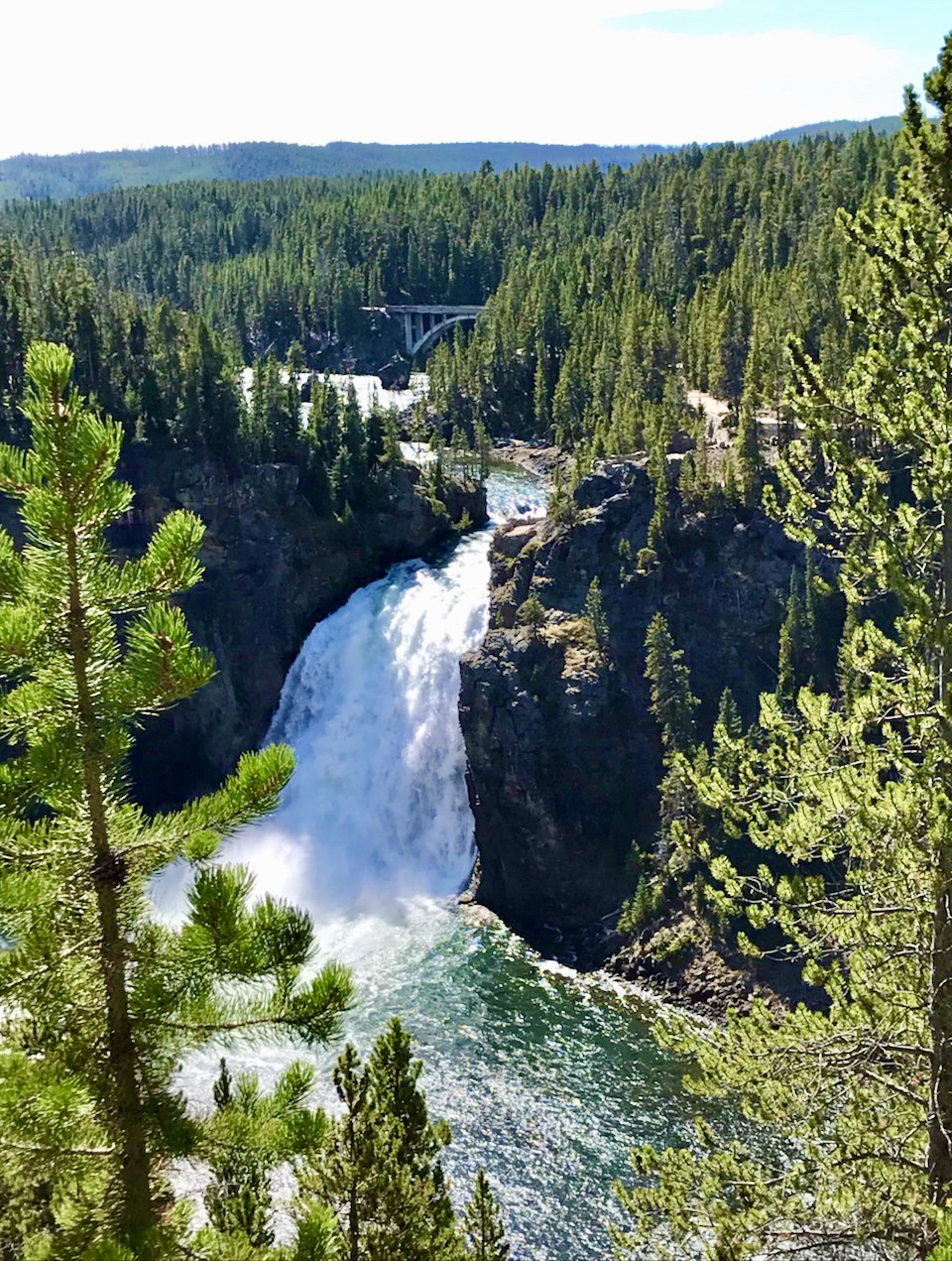
Ever since I was a small kid, it has been engrained in me that of all our national parks, there is one that is our premier and most pristine park–Yellowstone. I visited it with my parents in my teens, we took our children there in the 1980s, and we just returned from visiting again in September. The place is unchanged. The wildlife, the geysers, hot springs and the Canyon and Falls of the Yellowstone River–remain, as they have always been, a place of monumental natural wonder.

Prior to going this time, I read some old histories including that of Hiram Chittenden, one of the early Superintendents of the Park. It was relatively late in our national life, after the Civil War, before a group of explorers, geologists and academics went into this untouched area and came back to Washington, D.C. recommending that it be preserved as a National Park. It was so established in 1872.

Think about that. Ulysses Grant was President, Wyoming was not yet a State, and there was no National Park Service! In an unprecedented move, Congress created an area larger than the States of Rhode Island and Delaware combined to be preserved in perpetuity for its natural wonder and beauty.

An area larger than the States of Rhode Island and Delaware combined to be preserved in perpetuity for its natural wonder and beauty.

For decades, since there was little federal presence in this part of the West, the Park was administered by the Army Corps of Engineers. As soon as the railroads discovered what a magnet this gem of real estate would become, they made attempts at extending their tracks and presence into this wilderness. The answer was “No!” and it is still “No!” You can make your way into the park only by two-lane road and from just five entrances. There is no development allowed within the park, with the exception of some lodging facilities owned by the National Park Service.

It is inexpensive to visit the park, but not cheap if you stay overnight in a hotel. There are also no neon signs or blinking lights advertising the next fast-food restaurant or big-box store. If you do stay over-night, don’t expect a fancy restaurant–you are more likely to find a cafeteria with a limited menu. It is also difficult to get Wi-Fi or cell phone service.

By design, the park is a preserve. It opens in May and closes in October. Since most of the terrain is 7,000 or 8,000 feet above sea level, Yellowstone has a short summer. Its roads are officially closed during the winter with the exception of specially equipped snow vehicles that operate between Mammoth Hot Springs and the lodge at Old Faithful.

The geology is young. The explosive caldera that the Park sits on produced, over the last 2 million years, most of what you see. In geologic time that is like yesterday. The continental divide runs across this high plateau. Some of its waters run east to the Missouri River and on to New Orleans via the Mississippi. The Snake River drains south and then West to the Columbia River and then to the Pacific. Within the Park you will find incredible white water and dramatic waterfalls. Yet, there are also beautiful, clear trout streams meandering through scrub brush and grassy meadows.

Traffic moves slowly. Lines build up when a bison herd crosses a roadway. An elk or antelope siting brings out cameras and binoculars. Don’t expect to rush through Yellowstone National Park.

There are not a lot of flags flying except at major Park installations. Yet, you feel patriotic and glad to be an American as you travel though Yellowstone. It makes you realize that the foresight and vision of earlier generations have made possible what you can still see today. 


Rolland Kidder 


The Mystique of Living Here

It is not easy to describe the “mystique” of living around here, but you know it when you see it.

I see it often in the morning when I pick up the paper at Hogan’s Hut and listen to the bevy of truck drivers, linemen, and construction hands talking as they purchase their morning coffee and breakfast sandwich. It isn’t deep intellectual conversation, but it is real–about the weather, the morning news, sports or what happened in their families over the week-end.


The talk is non-pretentious and friendly. It reflects the concerns of making a living and raising a family. No one is on a “high horse” trying to sell an opinion. The conversation is about the challenges and reflections of everyday life. It is part of what draws me to go down and buy the paper. How do you describe something like this?

You get glimpses of it at hunting camp. How can you describe sitting around in an old trailer or cabin trading “war stories” and talking about the big buck that you saw which is still out there? You sense it sitting in a sugar shack in the Spring watching sap boil. Sometimes, even when they are having a bad year, you get it in the optimism of Bill’s fans at a tailgate party.

There are times when I have attended an exceptionally good concert at the Civic Center, or seen a student production or sporting event at a local school when the feeling comes. It is often present when you sit down with friends of many years over a glass of wine and reminisce about old times.

It is hard to describe but there is a love for this place and this community which is really difficult to explain in just rational terms.

My brother recently related an experience to me illustrating this. He had gone to a “celebration of life” event for a friend of ours who had been tragically killed in a truck accident. This man had been in the trucking business his whole life and had obviously made a lot of friends. The celebration began at the shop where he had worked from for most of his life, and ended at the volunteer fire department where he had been a long-time member and leader. A dozen or more road tractors (the kind which make-up 18 wheelers) showed up for the parade. Fire trucks joined in. There were also a number of Harley’s ridden by friends. This man had made a positive impact in the lives of many people, and this was their way of saying “thanks.”

How do you explain the power and meaning of something like this unless you live around here? It would be hard to explain to someone living in Manhattan or L.A. But, you know it when you see it. There is a mystique, a mystery, a meaning to all of this. If you live here, you know what I mean.

So, all of this to say that I am not moving anyplace else. How could there be a better place to live? I can’t always explain it, but I know it when I see it.

Rolland Kidder
is a Stow resident.


Saturday, October 12, 2019

The Nixon Tapes and Now

I had predicted in an earlier article that the Democrats in the House would not bring impeachment proceedings against Donald Trump. I was wrong. After revelations of his conversation with the President of Ukraine, Nancy Pelosi, Speaker of the House, authorized an “inquiry” into impeachment proceedings against the President. 


My earlier prediction was based upon the fact that impeachment would fail in the U.S. Senate; and so why waste the time of the people of the United States in an effort which was doomed to failure? What has changed is the President’s own recent admission that he was trying to influence a foreign government to bring down Joe Biden.

So far, we have been getting “redactions” and summations of what the President said to the leader of Ukraine. A “whistleblower,” still unknown, says that the White House has covered up the complete conversation of the President. It all reminds me a bit of 1974.

In the Watergate scandal, there was an inside source, known as “deep throat” who “spilled the beans” about the break-in at the Democratic headquarters in D.C. When it became known that the President knew of and had authorized the operation and that there had been a taped conversation and a cover-up–a subpoena was issued for the tape. That matter went all the way to the U.S. Supreme Court and in a unanimous decision the Court essentially ordered the White House to give up the tape.  (United States v. Nixon, 1974)

When that happened, we all know what happened next. President Nixon got in his helicopter, gave his last “V” for victory salute, and relinquished the Presidency to Vice President Gerald Ford. He was then pardoned by the new President Ford, and the country moved forward.

There are differences today but also similarities. Assuming that the “inquiry” by the House results in articles of impeachment, the matter will end up in the U.S. Senate. There, the future of Donald Trump’s Presidency will be in the hands of his own party. In 1974, though Democrats were in the majority in the Senate, Republican Senators controlled the impeachment process because 67 votes (two-thirds) were needed for conviction. When the tapes were ordered released, a group of Republican Senators, including Barry Goldwater, went to the White House and told President Nixon that probably only 15 Senators would support him, far less than needed to stop an impeachment. 

“I could stand in the middle of 5th Avenue and shoot somebody and I wouldn’t lose any voters. It's like, incredible.”     – Donald Trump

President Trump said during his last campaign that his supporters would back him, no matter what he did. “I could stand in the middle of 5th Avenue and shoot somebody and wouldn’t lose any voters,” he said, “It’s, like, incredible.” That sentiment could continue to hold, or it could change depending on what more comes out during the inquiry.

U.S. Senators tend to have a longer-term view of things. The framers of the Constitution gave them longer terms (6 years) than either the President (4 years) or Representatives in the House (2 years.) That is probably why Senators were given the last say in something as serious as removing a President from office.

If evidence builds that President Trump violated his oath of office or committed a crime, it is possible that history could repeat itself and we could have President Pence in the White House before this is over.

Rolland Kidder
This article first appeared in The Post Journal.


Sunday, July 28, 2019

Words Make a Difference


Words, especially those used by national leaders, make a difference.

The words that President Trump used in three “tweets” on, Sunday, July 14th were especially divisive. This is what he said:

Donald Trump:
“So interesting to see ‘Progressive’ Democrat Congresswomen, who originally came from countries whose governments are a complete and total catastrophe, the worst, most corrupt and inept anywhere in the world [if they even have a functioning government at all], now loudly and viciously telling the people of the United States, the greatest and most powerful Nation on earth, how government is to be run. Why don’t they go back and help fix the totally broken and crime infested places from which they came. Then come back and show us how it is done. These places need your help badly, you can’t leave fast enough. I’m sure Nancy Pelosi would be very happy to quickly work out free travel arrangements.”

That those in his base would be shouting “send her back!” at his next political rally should not come as a great surprise.

A little more than a week earlier, the President had stood on the steps of the Lincoln Memorial on the 4th of July. I wish that he had gone inside and read the words of Lincoln. Lincoln was a President, presiding over a much more divided Nation, then engaged in a catastrophic Civil War. The words of Lincoln in his second inaugural address did not attack, they did not blame, they did not attempt to divide. They were words of prayer, healing and of restoring unity to a torn country, and ended with hope for a better time: 


Abraham Lincoln:
“With malice toward none, with charity for all, with firmness in the right as God gives us to see the right, let us finish the work we are in, to bind up the nation’s wounds, to care for him who shall have borne the battle and for his widow and his orphan, to do all which may achieve and cherish a just and lasting peace among ourselves and with all nations.”

Words make a big difference. They also reflect the character of those who speak them. We need to be healing the Nation’s wounds, not promoting divisions based on our fears or differences. That may be an effective election strategy, but it is not the American way that I was taught. 


Rolland Kidder
This commentary appeared in the The Post Journal on July 28, 2019


unsplash-logoDan Girgis

Thursday, July 11, 2019

D-Day is a time to reflect


National World War II Memorial, Washington, D.C.

For the past decade or more, I have been on the Board of an organization, Friends of the World War II Memorial, that helps sponsor events at the National World War II Memorial in Washington, D.C.  Though we co-sponsor five days of national commemoration with the National Park Service, including Veterans Day and Memorial Day, perhaps our biggest event took place this year with the 75th Anniversary of D-Day, June 6, 1944.

D-Day is not an official holiday in the United States. The Post Office stays open, kids go to school and life goes on as usual. Yet, something deep in the American psyche is touched on D-Day. The nation can’t or won’t let it go.

Everything, of course, about what happened on D-Day was big: the largest amphibious attack force in world history, the courage displayed in places like Omaha Beach and Point Du Hoc, the decision to delay the invasion for a day because of the weather, the struggle to get off the beaches in Normandy and begin the liberation of Europe. Freedom itself was at stake and victory wasn’t guaranteed.

But today what seems to motivate its remembrance by Americans is the nostalgia of a better time. A time when Americans were all “pulling on the same oar,” when our goals and objectives were clear and people responded to the call. There is yearning to again recapture that spirit.

It almost seems impossible to conceive of something like D-Day happening again. It is hard to even comprehend such a world-wide conflict and one wonders whether civilized society would have the strength and resilience to rise up and defend itself today if we faced a similar challenge.

One of our Board members, Elliott “Toby” Roosevelt III, great grandson of President Franklin Roosevelt, reflected this year on the occasion of the 75th anniversary suggesting that the nation’s feelings about D-Day relate to the idea of sacrifice:

“When compared to the sacrifices of the men who hit the beaches of France on that day… few of us have given much to merit the freedoms and protections we have enjoyed our entire lives.
- Freedoms and protections we love;
- Freedom and protections that we take for granted; and
- Freedoms and protections which the vast majority throughout history, have never known. 
When we were born, these were simply handed to us.”

Toby Roosevelt has a point. It could be the fact that others sacrificed for the greater good to preserve the freedoms we now enjoy–that makes D-Day so important. Whatever the reason, June 6 has become one of those days when we stop and ponder what it means to be American.

Rolland Kidder
This commentary first appeared in The Post-Journal on June 30, 2019


unsplash-logoJared Short