Thursday, November 24, 2016

A Letter to the Kids


November 20, 2016

Election Post Mortem—A Letter To The Kids

Over forty years ago, I returned to Chautauqua County from the Vietnam War and became involved in local politics. It started with a defeat in 1970 in a run for the New York State Assembly. After that, I was elected twice to the county legislature and then four times to the Assembly before leaving elected politics to become involved in the private sector. So I have experienced the “ups and downs” of our system of electing those who represent us in government. I also came to understand and respect the electorate and also to respect those who are willing to become involved in politics and run for public office.

Our democratic process will only work if citizens become involved, and if some of those citizens are willing to assume the responsibility of serving in public office. This last election campaign was not one of inspiration for younger generations of Americans, and so, after the election, I sent this letter to our four children.

“To the Kids:

You have already probably heard more than you need to about the election. In my view, the biggest casualty is probably the system itself. Who would want to run for President and endure the mud slog that we just went through?  Would you want to? Would you want one of your kids to?  The answer is probably “no.”

It made me think back to 1960. I was a Republican and a student at Houghton College. The concern then was that JFK was a Catholic and that if he were elected, the Pope would take over the U.S. government. Then, in fact, Kennedy did get elected, and the Pope didn’t take over. What we remember from that time now is the inaugural: “Ask not what your country can do for you. Ask what you can do for your country.” Out of that came the Peace Corps and lot of new recruits (like me) who got interested in government.

Compare that to what we just went through. “Lock her up!” “Drain the swamp!”  Who is going to be encouraged to give some time to government service after that? That is what concerns me most.

I hope that this past election doesn’t discourage members of our extended family from getting involved at some level in “giving back” through government service. We need people to run local governments, school districts and, maybe, here at the lake… sewer districts! I am sorry that our grandkids had to go through this ugly election. It is really better than that, and we need people involved as citizens. We are all shareholders in this corporation we call “America.”

So let’s not retreat into a cave and let somebody else deal with the problems. Maybe there is somebody out there who would make a good legislator, school board member, Assemblyman, Congressman… and who knows… President. This is America. What we need now is to have people “double down” and get involved!

Dad

Rolland Kidder is a Stow resident.


Tuesday, August 30, 2016

Father of the National World War II Memorial


On April 22nd, this year, one of my best friends died: Ambassador F. Haydn Williams of San Francisco.

In a prior posting, I wrote about the incredible life of Senator Robert Dole and his commitment to the Memorial and being co-chair of the campaign to raise the money to build it. Haydn Williams, also a World War II veteran, though not as well-known as Senator Dole, was the driving force behind finding the site, developing the design and then shepherding the whole idea of a national memorial through the myriad of approving agencies necessary to see it built. As one who served on his World War II Committee at the American Battle Monuments Commission (ABMC,) I witnessed the profound impact that Haydn had in seeing the World War II Memorial become a reality.

Haydn and Rolly reviewing architectural models of the WWII Memorial in Washington, DC

Starting in 1995 and, over the course of six years, this committee (also called the Site and Design Committee of the ABMC) met one week-end every 4 to 6 weeks in Washington, D.C. Haydn would fly in from San Francisco two or three days before the meeting to prepare for it, and then would stay on in the District for another few days after these meetings to follow through with decisions that had been made. He was a “task-master” in the best sense of the word, and would never accept anything but the best when it came to the World War II Memorial. On the occasion of a celebration of his life in May at the Memorial, many of those with whom he was associated came to pay their respects and voice their gratitude for what this remarkable man had accomplished. (Video of the service and reception in his honor, is available by going to the website of Friends of the National WWII Memorial at: www.wwiimemorialfriends.org.)

“Here, on the east-west axis of the Mall is where the Memorial should be. World War II was the defining event of the 20th century for our country. It should stand here between Lincoln and Washington, marking similar events in the 18th and 19th centuries.”  

Early in the site-selection process, our committee made a visit to 7 or 8 possible sites for the Memorial. It was raining and at the end of a day of visiting these sites in March, 1995 when Haydn stopped us as we walked around the old Rainbow Pool at the eastern end of the Reflecting Pool on 17th Street. “Here, on the east-west axis of the Mall” he said, “is where the Memorial should be. World War II was the defining event of the 20th century for our country. It should stand here between Lincoln and Washington, marking similar events in the 18th and 19th centuries.” At the time he said that, the old Rainbow Pool was not on the list of possible sites that had been given to us by the Commission of Fine Arts (CFA.)

After that meeting, Haydn went to see J. Carter Brown, Chairman of the CFA. Shortly thereafter, the Rainbow Pool was added as a potential site and was subsequently chosen by the ABMC to be the site of the National World War II Memorial. There was vehement opposition to this decision and at nearly every regulatory hearing (of which there were some 22 over the next 5 years) on approving design elements… opponents would come to try to derail the site selection. Haydn stood firm in spite of this opposition and would say when the Memorial was finally under construction: “When I look back on what happened, I think that perhaps my biggest contribution was in getting and keeping the site.”

The World War II Memorial stands there now, a testament to this man’s vision and tenacity of spirit. When he came to the Memorial for the last time in 2014 to celebrate its 10th year anniversary, he described the Memorial as “quietly taking its place as one of the historic icons on the National Mall…becoming, in a way, Washington’s village square, the town green on the Mall…a place to linger, to stroll, to listen and to share memory and meaning…. Nestled between Lincoln and Washington, the WWII Memorial stands as the singular most important event of the 20th century.”

There are few times in life when so much can depend on the vision and leadership of one man.  Ambassador F. Haydn Williams was one of those few without whom the National World War II Memorial would not be where it is, or be the magnificent memorial it has become.  More information on the life and service of Ambassador Williams can be found in his obituary printed in the Washington Post:  Haydn Williams Obituary.


Rolland E. Kidder


Friday, July 29, 2016

A Birthday Tribute to Senator Robert Dole


On July 15th, a week before he reached the age of 93, former Senator, Presidential candidate, and World War II veteran, Robert Dole, went to the World War II Memorial to welcome veterans of the 96th Infantry Division. Despite physical difficulties and advancing age, Bob Dole continues to lead and to welcome World War II veterans to their Memorial.

96th Infantry Division veteran Bub Simmons and his wife, Fay, greet Senator Dole at the World War II Memorial.

Park Service volunteer, Donna Prince, wishing Senator Dole a "Happy Birthday."

These photos show him being greeted by a veteran of the 96th as well as by Donna Prince, a National Park Service volunteer whose parents and family were interred as Japanese-Americans during the Second World War. Interestingly, Bob Dole was wounded in Italy during the war fighting nearly side-by-side with Japanese-American soldiers. His friend, Senator Dan Inouye (deceased), as was Bob Dole, was wounded fighting the Germans in the mountainous area north of Florence.

I first met Bob Dole in 1997 at the White House when President Clinton invited him to attend an event announcing the winning design for the World War II Memorial. Despite the rigors of the 1996 Presidential campaign, Senator Dole was gracious with a sense of humor when introduced that day by President Clinton. He started his remarks by saying: “I thought that when the President invited me here today, that he was going to hand me the keys to this place!” Everyone laughed and then Dole went on to remark about the significance of the Second World War, the importance of remembering it and never forgetting the sacrifice and dedication of the American people which brought forth the victory. 

“I thought that when the President invited me here today, that he was going to hand me the keys to this place!”

It was either that day or shortly thereafter, that the President asked Senator Dole to Chair the effort to raise the funds to build the Memorial. Senator Dole said “Yes” and also asked that there be a Co-Chair to help him. An affirmative response to this came when Fred Smith, the Chairman of the FEDEX Corporation, agreed to help. The two of them, Dole and Smith, went on to conclude one of the most successful fundraising efforts ever conducted for a Memorial in Washington. Before it was done, nearly $200 million had been raised from the American people to build the iconic Memorial what now stands on 17th Street, on the East-West Axis of the Mall, between those named for Lincoln and Washington.

For Bob Dole, that was only the beginning. Ever since the National World War II Memorial was dedicated in 2004, he has, whenever possible, been at the Memorial to welcome his fellow World War II veterans. He has been an inspiration to them and to all of us. On the occasion of his 93rd birthday, it is fitting that all Americans pay tribute and give thanks to Senator Robert Dole for what he has done for the country and, specifically, for his dedication to the cause of building a World War II Memorial in our nation’s capital.


Rolland E. Kidder


Saturday, July 2, 2016

Thoughts for the 4th of July


The Frailty of Human Institutions

It wasn’t that long ago (the 20th century) when Europe was consumed twice by war which resulted in the deaths of millions. The countries of Europe lined up along national/ideological lines, formed alliances and then went to war to settle their differences. Whatever the cause, including naked aggression by some states against others, the results were devastating. It is good to remember on the 4th of July that thousands of American soldiers, sailors and airmen also perished in these conflicts and many are buried in American cemeteries in Europe.

After the Second World War, tired and impoverished by war but with the help of the American Marshall Plan, Europe slowly began to rebuild itself by entering into cooperative working agreements and by creating such institutions as NATO and the European Union (EU.) Now, 70 years later, we are facing the reality of an “unwinding” of those institutions and relationships. The recent vote in Britain to leave the EU should be of concern to everyone, including Americans. Like it or not, our country has been inextricably entwined in events in Europe for the past 200 years, including its wars.

One generation does not necessarily build on the experiences of prior generations. Over time people forget. It takes years of dogged determination to build agreements and trust between nations. It can all come tumbling down quickly. This seems to be what happened in the recent “Brexit” vote to leave the European Union. People want quick solutions to their perceived problems, but most problems are complex and solutions take time.

Building a united Europe has never been easy. Every nation in the EU has a different language or culture. In the 17th century, the continent was also split along religious lines (Protestant vs. Catholic). During what was called the “Thirty Years War”, it is estimated that nearly a quarter of the people living in Central Europe (now Germany) were killed. Sadly, the history of fighting and war in Europe is much longer and more well-established than its more recent history of working together.

The “Brexit” is more than a ho-hum moment in history. It could lead to further divisions in Europe and more political instability. Human institutions are vulnerable. Americans should be concerned. Cutting ourselves off from Europe is something we couldn’t do even if we wanted to. It is always easier when going to the polls to just get mad, vote “No” and pull oneself into a self-protective cocoon. Unfortunately, that usually doesn’t solve problems. For America’s sake, let’s hope that Europe can figure out a way to keep itself together.


Rolland Kidder
Ashville, NY


Thursday, June 2, 2016

Founding Flyers

April 20, 2016 was the 100th anniversary of the founding of the United States Air Force.  Ceremonies marking the occasion were conducted at a beautiful memorial west of Paris dedicated to the Lafayette Escadrille, an American flying squadron formed in World I to fly with the French.

The beginning for Americans flying in combat started with some young American men who were living in Paris when World War I broke out.  They felt compelled to “enter the fray” on the side of France, an old American ally going back to the Revolutionary War.  They were advised at the time, in 1916, that the United States was still technically a “neutral” in the First World War.   That did not deter them.   They joined the French Foreign Legion, began their flight training under French command, and soon were engaged in aerial combat with the Germans over the trenches east of Paris.  They took the name “Lafayette” from the French General who had been part of George Washington’s Continental Army.  Their logo, painted on their planes, was an American Sioux Indian headdress.

It was a risky time in military aviation.  Airplanes were new and aerial combat untested.  A year later (1917), when the United States entered the war, they would be attached directly to the U.S. Army which had established its own Air Service command.  Before the war ended on November 11, 1918 many of these flyers had been killed.  At war’s end, a French foundation supported by private philanthropy from the United States, built a Memorial to these earliest American combat flyers.  38 American pilots are buried there in a sarcophagus beneath a Memorial reminiscent of the Arch D’ Triumph.


French Fighter Jet Formation over Lafayette Escadrille.  Lead aircraft painted American red, white and blue.


Last month, on April 20th, United States and French air power came in force to remember these pioneers of military aviation. There was a fly-by of jet fighters and, at the end of the ceremony, a B-52 bomber flew over the site. It almost defies logic that something as historic and mammoth as the U.S. Air Force could have such humble beginnings: a small group of dedicated American volunteers banded together to fly for what they believed to be the just cause of an American ally.

Over the past three years, the American Battle Monuments Commission, supervised a renovation of the Lafayette Escadrille Memorial.  After the ceremony, the commission voted to make the Memorial an integral part of the American memorials and cemeteries where our overseas war dead are buried.  As one of our commissioners, an Air Force veteran, said with great emotion when the vote was taken:  “Now, we have brought our boys home.”


Lafayette Escadrille Memorial Re-Dedication, April 20, 2016

Though the young men who died fighting in skies of France in World War I faced fear and death, I have never known any pilot who did not first love and appreciate the beauty of flying and the thrill of being in the sky.  25 years later, in World War II, another American pilot similarly volunteered and died flying Spitfires for the British Royal Air Force.   Prior to his death, John Gillespie Mcgee Jr. wrote this poem which he sent to his parents

                 “Oh!  I have slipped the surly bonds of Earth
                  And danced the skies on laughter-silvered wings:
                  Sunward I’ve climbed, and joined the tumbling mirth
                  Of sun-split clouds—and done a hundred things
                  You have not dreamed of—wheeled and soared and swung
                  High in the sunlit silence.  Hov’ring there,
                  I’ve chased the shouting wind, and flung
                  My eager craft through footless halls of air….

                  Up, up the long, delirious burning blue
                  I’ve topped the wind-swept heights with easy grace
                  Where never lark, or even eagle flew—
                  And, while with silent, lifting mind I’ve trod
                  The high untrespassed sanctity of space,
                  Put out my hand, and touched the face of God.”

As with those buried at the Lafayette Escadrille Memorial, John Gillespie Magee, Jr. was a young man.  He was nineteen years old when he died. 


Rolland Kidder
Stow, NY
Commissioner, American Battle Monuments Commission
                 
Photos courtesy of the French Ministère de la Défense


Sunday, April 10, 2016

"Rosie the Riveter" veterans honored at World War II Memorial


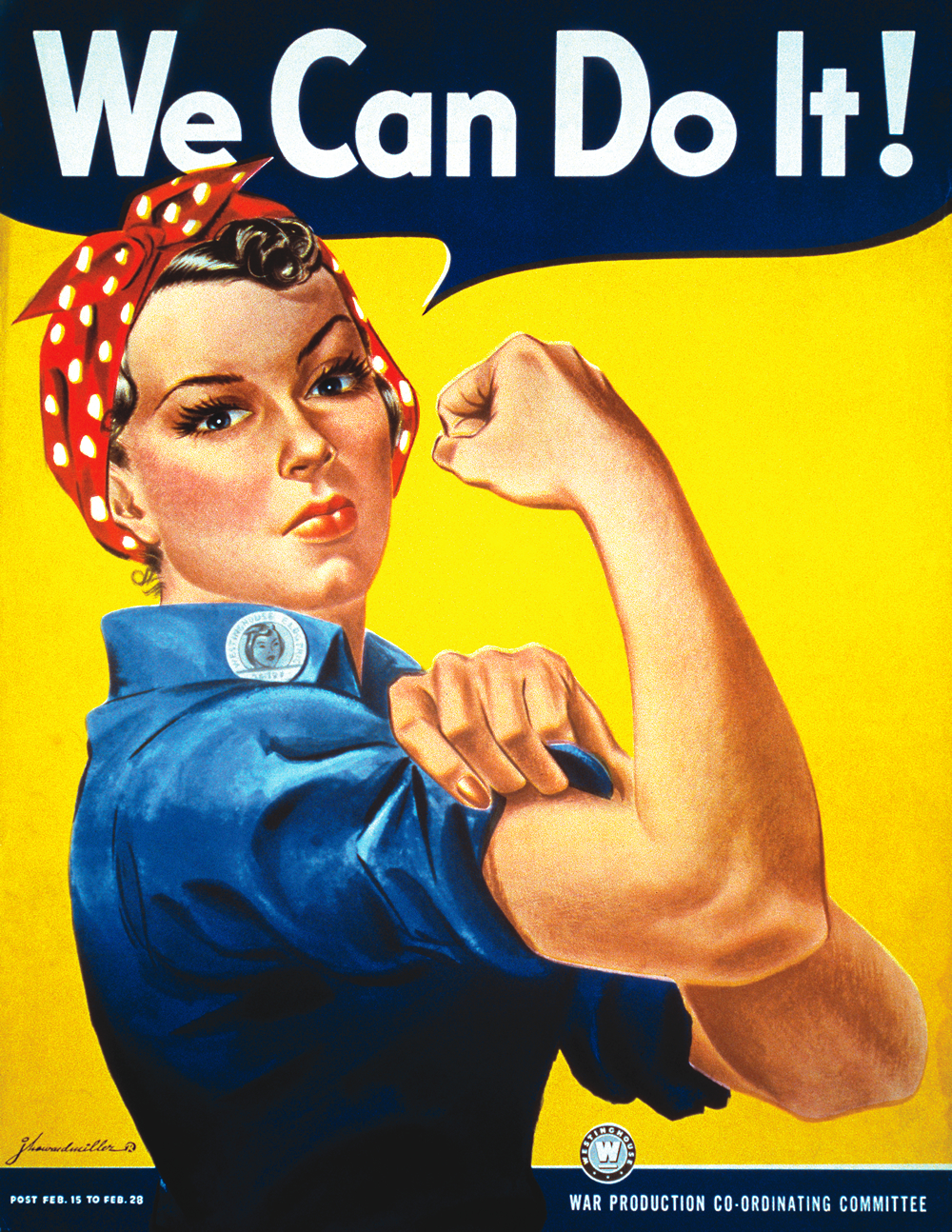
On March 22, 2016 a group of “Rosie the Riveter” veterans sponsored by Honor Flight in Detroit visited the World War II Memorial. During the Second World War these women and thousands like them worked at industrial plants around the country to manufacture the goods necessary to win the war. A recruitment poster designating them “Rosie the Riveter” became a part of story of World War II. They built everything from planes and ships to jeeps and machine guns.

Never before had women been so involved in the industrial production of the country. Their participation in the home front effort forever changed the role women would play in the workforce. The importance of their contribution in winning the war is engraved in stone and bronze at the National World War II Memorial.


"Rosie the Riveter" from Republic Pictures, 1944

Saturday, March 12, 2016

OV-10A Bronco Firefight Audio

Excerpted from Backtracking in Brown Water, by Rolland E. Kidder


A U.S. Navy Rockwell OV-10A Bronco of light attack squadron VAL-4 Black Ponies attacking 
target with a 12.7 cm (5 in) "Zuni" rocket in the Mekong Delta, South Vietnam, ca. 1969/70. 


00:15  /  The first part of this tape is a re-recording of an OV-10 Bronco air strike on the Vinh Te Canal.  I am listening to and recording the events of a previous night when a PBR boat captain had recorded the sounds of this air strike.   He and I are laughing and commenting on what occurred.   At one point, a siren goes off, the signal to stop firing.  Then a Vietnamese sailor yells at a local outpost for them to cease firing.  The outpost had been firing mortars into an area where these Navy strike aircraft (with the call sign “Black Pony”) were flying.   From the tape, you can hear metal falling on the deck of the PBR as the machine guns are fired.   Tracers from PBR machine guns were often used to support air strikes by marking the location of enemy positions.  The sound of the twin engine OV-10’s can be heard as they fly low over the boat on their strafing runs toward the target.

04:15 / On October 26, 1969, I tape-recorded the radio traffic during an enemy attack against our heavy River Assault Group boats.  The position of our PBR was about a mile from the encounter.  We could see the firefight in the distance.  The call sign for the RAG boat commander was “Brass Rail”, and individual boats under attack are designated by various letters of the phonetic alphabet.  U.S. Navy Seawolf helicopters and fixed wing Black Pony attack aircraft can also be heard calling in.  A RAG boat radio sometimes remains keyed in the “on” position and you can hear yelling and firing in the background. The tape accurately describes the chaos, anxiety and fear experienced in a firefight.  


AUTHOR'S NOTE:
Since publishing Backtracking in Brown Water, I continue to receive inquiries about this firefight audio link found on page 130.  The QR code provides readers with a direct link to audio files I submitted to the Internet Archive, a non-profit digital library dedicated to preserving artifacts of culture & heritage.


The recording itself came from a tape recorder that I had taken on one of the multi-day patrols on the Vinh Te Canal. (It was one of those small, cassette tape recorders that I had purchased in a Navy PX someplace.) While in Vietnam, I periodically sent tapes home to friends and family instead of writing a letter. On this occasion, I used it to actually record some of the "goings on" on the Vinh Te Canal. The first vignette includes some background discussion between myself and a boat captain of an airstrike he had recorded a prior night. The second occurs on another night when I turned the recorder on during a firefight between the enemy and the RAG boats.  

Fortunately, when I got back to the YRBM 20 after this patrol, I made some copies of the tape. One of them got to an Admiral who queried Mike Connolly about it (see page 125)

Sunday, March 6, 2016

EDITORIAL: Politics on the Margins


One of the sad developments this year in national politics is that, at least in early primary elections and caucuses, discussion has been polarized at the margins of political discourse.

On the Republican side, you have one candidate after another trying to out "anti-immigrant" the other. Who can build the biggest fence along the Mexican border? And how about this "I will get the Mexican government to pay for it!" 

On the Democratic side, you have a candidate promising tuition-free college for everyone, yet nothing is said about how this would be paid for. "Medicare for all" he says, but, again, nothing realistic is proposed as to how the nation would pay for that. "Taxing the rich" is not an answer since we all would have to pay more to meet these new financial obligations. 

In the middle of all of this sits the American public consisting mostly of common sense people who aren't asking for much other than that the country be sensibly governed by a leader who can balance the various interests of the Nation (and the world) and try to keep us out of war. 

Maybe this polarization will end with conclusion of the primaries, but I doubt it. The Republican leader of the U.S. Senate has vowed not to confirm any Supreme Court Justice proposed by the President before the election. Apparently, he wouldn't even consider a qualified Republican should the President submit such a name for appointment to the U.S. Supreme Court. It appears that fulfilling the constitutional obligation of appointing judges will have to wait until the craziness of this Presidential election is over. 

The rest of the world must be scratching its head. "What has happened to the Americans?" This is a country of immigrants, and is the nation that rebuilt its enemies after World War II. It is a country that prides itself on the rule of law and of finding solutions to common problems. It now seems to be a nation "on the brink" whose politics are running on fear, venal personal attacks and profane one-liners.

"Our concerns used to be ameliorated by the understanding that, in the end, common sense would prevail; and that there were adults in the room who would finally be elected to lead the country."

I suppose that we should keep our cool and not be alarmed, but something has invaded our political discourse. We don't talk with each other but at each other. We don't seem to be seeking ways to find common ground, but to accentuate differences based often upon the absence of truth. Our concerns used to be ameliorated by the understanding that, in the end, common sense would prevail; and that there were adults in the room who would finally be elected to lead the country. 

This year something different is going on with our politics, and it is not healthy.

Rolland E. Kidder


Wednesday, February 3, 2016

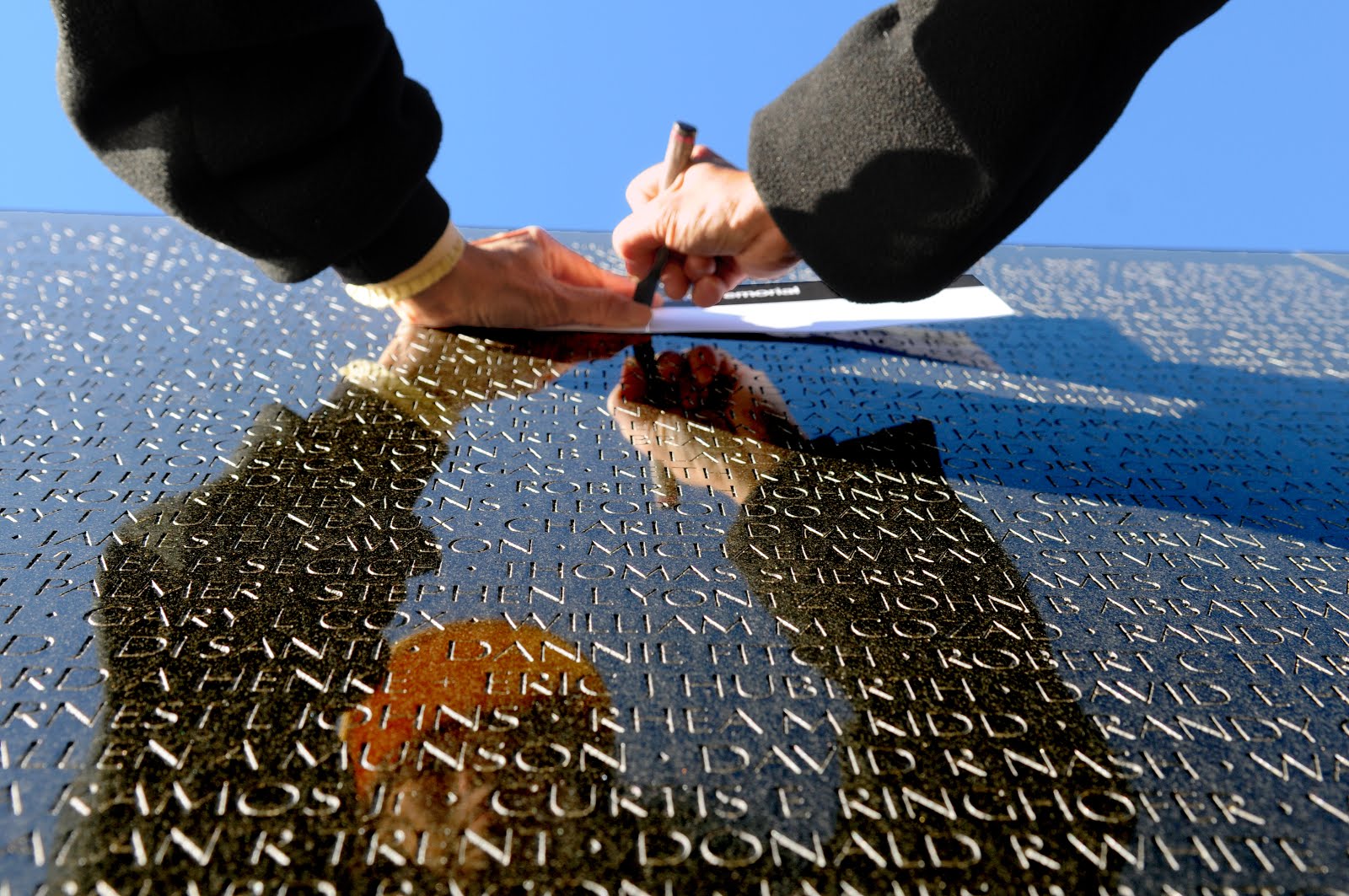
Vietnam Memorial Wall Rubbings

Leslie H. Sabo Jr.

One of eight men of the "B"/ 3 / 506, 101st Airborne Division (Airmobile) 
who were killed on May 10th, 1970 during Operation Binh Tay 1.

Rubbings courtesy of Dan Arant


Saturday, January 9, 2016

Christmas at the Vietnam Veterans Memorial

For Vietnam veterans, The Wall in Washington, D.C. still elicits vivid memories. National Park Service volunteer, Dan Arant, recently took these photos (edited by Donna Prince) on Christmas Day and on December 12th when the Christmas Tree Ceremony was held. Dan is also a volunteer at the National World War II Memorial.  National Park Service Volunteers wear yellow hats and shirts while “on duty” at our nation’s memorials in Washington.  We all benefit from their volunteer service and are grateful for their commitment to public service at these important sites.

Rolly Kidder


Saturday, November 28, 2015

2015 Veteran's Day Ceremony at the National World War II Memorial


For the past several years, I been honored to serve on the Board of Friends of the National World War II Memorial in Washington, D.C . This organization is a partner with the National Park Service in sponsoring 5 days of national commemoration at the Memorial, including Veterans Day.

The attached photographs were taken before the ceremony began and then immediately after it concluded. One reveals the centrality of this time in our nation's history... the podium situated right on the east-west centerline of the National Mall. The other photo shows the crowd gathered around the wreaths in front of freedom wall at the end of the event, a visible reminder of the sacrifice made by over 400,000 of our fellow Americans who perished during the war.

A video of the Veteran's Day ceremony can be found on the Friends' website at Friends of the National WWII Memorial.  Also, on the website is a video of our third annual Haydn Williams' Legacy Lecture given this year by Tom Brokaw. It is an incredible 1 hour talk (without notes) of his experience growing up in the post-war years, and of his reasons for writing the book which is now a part of the World War II lexicon... "The Greatest Generation."


Rolland Kidder


A Veteran's Day Tradition in Jamestown, NY


As far as I know, this ceremony has been going on since the end of the First World War at the corner of 3rd & Main.  Kudos for the Jamestown High School band.

Rolly Kidder

Tuesday, October 27, 2015

The Dedication of Eldon W. Tozer Square

It was an honor for me recently to participate in the last dedication ceremony for Natick, Mass. residents who were killed in the Vietnam War. In a noon-time ceremony, the name of Eldon W. Tozer became a part of the “Natick 11” who gave their lives serving in Vietnam. A sign was unveiled at the corner of Marion St. and Lincoln Place, now called “Eldon W. Tozer Memorial Square.” 


Though he is buried in Cullen’s Brook, Quebec and was a Canadian, Eldon joined the U.S. Navy while living with his sister and working in Natick. In a sense, he is an “adopted son” of the Natick community. It was moving and powerful for them to honor him in this way.

Jim Tucceri unveils the sign designating “Eldon W. Tozer Square.”

Jim Tucceri, Eldon’s nephew, participated in the ceremony by unveiling the sign designating the new Eldon W. Tozer Square. The home where Jim grew up and where Eldon lived is just four houses down the street from where the sign is located. Resolutions passed by both the House and the State Senate of Massachusetts were presented to Jim (representing the Tozer family,) as was a letter from the Province of Quebec. Special thanks go to Paul Carew (Veterans Agent of Natick), Maureen Sullivan, (Co-coordinator of Natick Veterans Oral History Project), and Josh Ostroff (Natick Board of Selectman) for their leadership in organizing the event.

I read into the record a statement with a strong personal touch which was sent to me by the sister of Eldon Tozer, Frances Tozer Gregoire:

“I was nine years old when he was born. I thought he was sent from Heaven. He was born at home at night, and I heard his first cry. 
I helped take care of him because I was the oldest girl. He was always quiet and very interested in nature. When he was young, he enjoyed watching bugs and spiders. He loved the little things in life. 
During his late teen years, he lived with me, my husband and our children. 
I don’t remember how old he was when he moved to Natick to be with my sister Mona. He worked in a baseball factory there before he joined the Navy. He never gave up his Canadian citizenship. I looked forward to his visits back home.”


It was cold and overcast the day of the ceremony, but I am sure that everyone present was warmed by the beauty and simplicity of the occasion. Local and state representatives were there, a Sargent-Major from a U.S. Army base was present, and an honor guard of veterans with a firing squad provided military honors. Eldon Tozer would have been pleased that he was being remembered by a caring community which has never forgotten him or the sacrifice that he made while serving with the Armed Forces of the United States of America.

Rolland Kidder


Jim Tucceri, Eldon’s Nephew, and author.

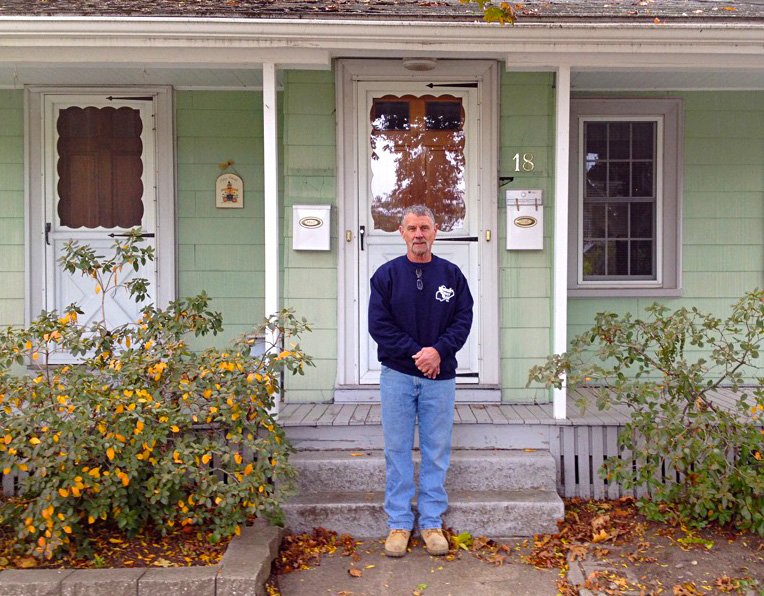
Jim Tucceri standing in front the house he grew up in, and where 
Eldon Tozer lived before he joined the U.S. Navy in 1957.

Official letter from the Quebec Consul - read at the dedication by
Josh Ostroff, Natick Board of Selectmen


Wednesday, September 30, 2015

Navy River Divisions 515 / 535 are reunited at Hampton, Virginia event


Butch Jarvinen and Rolly Kidder of River Division 535 share some stories

Butch Jarvinen and I served together in River Division 535, from 1969-'70 in the Mekong Delta. Jarvinen lives in rural Virginia and he joined myself and other Navy veterans at an Army Sea Tigers Reunion in Hampton, Virginia.  The Sea Tigers also operated PBR's during the Vietnam War.  The two PBR's present at the reunion were restored by Dennis Ambruso and David Pizzoferrato. Ralph Richason, River Division 515, helped coordinate the event for Navy veterans.  Ralph Fries, a PBR Vietnam veteran who has documented all of the Navy PBR men killed in action, presented his documentary work as a part of the reunion event.  Following are pictures and a writeup on the reunion event.

Rolly Kidder 


Vietnam era PBRs (Patrol Boat, River) on display for returning veterans in Hampton marina
PBR's with current Navy boats called RIB's (rigid-inflatable boats)
A US Navy Officer addresses veterans in front of Dennis Ambruso (leaning on the .50 cal Machine gun).
Dennis restored the PBR boat on display this weekend.