Saturday, October 12, 2019

The Nixon Tapes and Now

I had predicted in an earlier article that the Democrats in the House would not bring impeachment proceedings against Donald Trump. I was wrong. After revelations of his conversation with the President of Ukraine, Nancy Pelosi, Speaker of the House, authorized an “inquiry” into impeachment proceedings against the President. 


My earlier prediction was based upon the fact that impeachment would fail in the U.S. Senate; and so why waste the time of the people of the United States in an effort which was doomed to failure? What has changed is the President’s own recent admission that he was trying to influence a foreign government to bring down Joe Biden.

So far, we have been getting “redactions” and summations of what the President said to the leader of Ukraine. A “whistleblower,” still unknown, says that the White House has covered up the complete conversation of the President. It all reminds me a bit of 1974.

In the Watergate scandal, there was an inside source, known as “deep throat” who “spilled the beans” about the break-in at the Democratic headquarters in D.C. When it became known that the President knew of and had authorized the operation and that there had been a taped conversation and a cover-up–a subpoena was issued for the tape. That matter went all the way to the U.S. Supreme Court and in a unanimous decision the Court essentially ordered the White House to give up the tape.  (United States v. Nixon, 1974)

When that happened, we all know what happened next. President Nixon got in his helicopter, gave his last “V” for victory salute, and relinquished the Presidency to Vice President Gerald Ford. He was then pardoned by the new President Ford, and the country moved forward.

There are differences today but also similarities. Assuming that the “inquiry” by the House results in articles of impeachment, the matter will end up in the U.S. Senate. There, the future of Donald Trump’s Presidency will be in the hands of his own party. In 1974, though Democrats were in the majority in the Senate, Republican Senators controlled the impeachment process because 67 votes (two-thirds) were needed for conviction. When the tapes were ordered released, a group of Republican Senators, including Barry Goldwater, went to the White House and told President Nixon that probably only 15 Senators would support him, far less than needed to stop an impeachment. 

“I could stand in the middle of 5th Avenue and shoot somebody and I wouldn’t lose any voters. It's like, incredible.”     – Donald Trump

President Trump said during his last campaign that his supporters would back him, no matter what he did. “I could stand in the middle of 5th Avenue and shoot somebody and wouldn’t lose any voters,” he said, “It’s, like, incredible.” That sentiment could continue to hold, or it could change depending on what more comes out during the inquiry.

U.S. Senators tend to have a longer-term view of things. The framers of the Constitution gave them longer terms (6 years) than either the President (4 years) or Representatives in the House (2 years.) That is probably why Senators were given the last say in something as serious as removing a President from office.

If evidence builds that President Trump violated his oath of office or committed a crime, it is possible that history could repeat itself and we could have President Pence in the White House before this is over.

Rolland Kidder
This article first appeared in The Post Journal.


Sunday, July 28, 2019

Words Make a Difference


Words, especially those used by national leaders, make a difference.

The words that President Trump used in three “tweets” on, Sunday, July 14th were especially divisive. This is what he said:

Donald Trump:
“So interesting to see ‘Progressive’ Democrat Congresswomen, who originally came from countries whose governments are a complete and total catastrophe, the worst, most corrupt and inept anywhere in the world [if they even have a functioning government at all], now loudly and viciously telling the people of the United States, the greatest and most powerful Nation on earth, how government is to be run. Why don’t they go back and help fix the totally broken and crime infested places from which they came. Then come back and show us how it is done. These places need your help badly, you can’t leave fast enough. I’m sure Nancy Pelosi would be very happy to quickly work out free travel arrangements.”

That those in his base would be shouting “send her back!” at his next political rally should not come as a great surprise.

A little more than a week earlier, the President had stood on the steps of the Lincoln Memorial on the 4th of July. I wish that he had gone inside and read the words of Lincoln. Lincoln was a President, presiding over a much more divided Nation, then engaged in a catastrophic Civil War. The words of Lincoln in his second inaugural address did not attack, they did not blame, they did not attempt to divide. They were words of prayer, healing and of restoring unity to a torn country, and ended with hope for a better time: 


Abraham Lincoln:
“With malice toward none, with charity for all, with firmness in the right as God gives us to see the right, let us finish the work we are in, to bind up the nation’s wounds, to care for him who shall have borne the battle and for his widow and his orphan, to do all which may achieve and cherish a just and lasting peace among ourselves and with all nations.”

Words make a big difference. They also reflect the character of those who speak them. We need to be healing the Nation’s wounds, not promoting divisions based on our fears or differences. That may be an effective election strategy, but it is not the American way that I was taught. 


Rolland Kidder
This commentary appeared in the The Post Journal on July 28, 2019


unsplash-logoDan Girgis

Thursday, July 11, 2019

D-Day is a time to reflect


National World War II Memorial, Washington, D.C.

For the past decade or more, I have been on the Board of an organization, Friends of the World War II Memorial, that helps sponsor events at the National World War II Memorial in Washington, D.C.  Though we co-sponsor five days of national commemoration with the National Park Service, including Veterans Day and Memorial Day, perhaps our biggest event took place this year with the 75th Anniversary of D-Day, June 6, 1944.

D-Day is not an official holiday in the United States. The Post Office stays open, kids go to school and life goes on as usual. Yet, something deep in the American psyche is touched on D-Day. The nation can’t or won’t let it go.

Everything, of course, about what happened on D-Day was big: the largest amphibious attack force in world history, the courage displayed in places like Omaha Beach and Point Du Hoc, the decision to delay the invasion for a day because of the weather, the struggle to get off the beaches in Normandy and begin the liberation of Europe. Freedom itself was at stake and victory wasn’t guaranteed.

But today what seems to motivate its remembrance by Americans is the nostalgia of a better time. A time when Americans were all “pulling on the same oar,” when our goals and objectives were clear and people responded to the call. There is yearning to again recapture that spirit.

It almost seems impossible to conceive of something like D-Day happening again. It is hard to even comprehend such a world-wide conflict and one wonders whether civilized society would have the strength and resilience to rise up and defend itself today if we faced a similar challenge.

One of our Board members, Elliott “Toby” Roosevelt III, great grandson of President Franklin Roosevelt, reflected this year on the occasion of the 75th anniversary suggesting that the nation’s feelings about D-Day relate to the idea of sacrifice:

“When compared to the sacrifices of the men who hit the beaches of France on that day… few of us have given much to merit the freedoms and protections we have enjoyed our entire lives.
- Freedoms and protections we love;
- Freedom and protections that we take for granted; and
- Freedoms and protections which the vast majority throughout history, have never known. 
When we were born, these were simply handed to us.”

Toby Roosevelt has a point. It could be the fact that others sacrificed for the greater good to preserve the freedoms we now enjoy–that makes D-Day so important. Whatever the reason, June 6 has become one of those days when we stop and ponder what it means to be American.

Rolland Kidder
This commentary first appeared in The Post-Journal on June 30, 2019


unsplash-logoJared Short


Sunday, May 19, 2019

Republicans are Bailing


It is not usually newsworthy when a state legislator switches political parties, but, recently, a news article caught my eye when the longest serving Republican legislator in the Iowa General Assembly announced that he was switching political affiliation to the Democrats. How could that be?

I did some research on this gentleman, named Andy McKean, and found that he had served both in the Iowa State Senate and the Assembly for a total of 24 years. The reason he gave for switching parties is that Donald Trump had become the face of the Republican Party.

“I believe that his actions have coarsened political discourse, have resulted in unprecedented divisiveness and have created an atmosphere that is a breeding ground for hateful rhetoric and actions,” McKean said. “Some would excuse this behavior as ‘telling it like it is” and the new normal. If this is the new normal, I want no part of it.” “Unacceptable behavior should be called out for what it is,” he added.

“Some would excuse this behavior as... the new normal. If this is the new normal, I want no part of it.”     - Andy McKean (R - Iowa)

To some, Mr. McKean might be suspect because he spent some time in the State of New York, and attended school at SUNY Oneonta. Perhaps he picked up some unknown liberal genes while residing in our fair State… and they have just come to fruition in Iowa. But, it is hard to make that argument when, for 24 years, he has represented a largely conservative, agricultural area in Iowa.

Some might be suspicious of him because he is a retired attorney and, on top of that, a square dance caller! But, let’s face it, this is not good news for Republicans. We are not talking about a young, progressive coming out of nowhere and deciding to switch parties. This is a person who is the longest serving Republican in the Iowa legislature.

I guess the article caught my eye, in part, because it identified, better than most arguments, why I have had trouble liking this President. It is not his policies or lack of government experience that most irk me… we knew going in that he had been elected, in large part, because he had no governmental experience and ran against the “elite” in government.

But, it is the “coarseness,” the continual goading and blaming, with demeaning attacks on people and institutions in four-letter “tweets” that have turned me against him. Despite having run (and both lost and won) in political campaigns, I never thought my opponent was a “jerk” or incompetent—or a pariah of some kind. Having a competitive race between good people who may disagree on some of the issues has been a hallmark of American politics.

One of my political idols around here has been Amo Houghton…our former Congressman.

One of my political idols around here has been Amo Houghton…our former Congressman. He is the only Chairman of a Fortune 500 Company to ever have been elected and served in the U.S. Congress. He was the epitome of competence and civility while he served. Last year, as a Republican, he came out and called for national unity and for replacing Donald Trump from the highest office in the land.

The Democrats though would be smart not to “take the bait” and get off on a tangent of impeachment which is certain to fail in the U.S. Senate. Instead, if more people like Rep. Andy McKean in Iowa start to switch parties and the Republican nominee is Donald Trump—the people will decide, and we will likely be having a new President starting in 2021.

Rolland Kidder
This commentary first appeared in The Post-Journal.


Sunday, April 21, 2019

Voter Participation


One day, when I was in the State Assembly, I had an interesting conversation with another Assemblyman who represented Harlem.  “How many people voted in your District in the last election?” I asked.  He said, “about 10,000.”  I was astounded, for in the same election, 40,000 people had voted in my Assembly District here in Chautauqua County and the population represented in each District was roughly the same.

Out of curiosity, I checked on some voting numbers for 2018, and found similarities.  For example, in our Congressional District, in the general election, Tom Reed received about 130,000 votes and Tracy Mitrano 110,000 votes… a total of 240,000 for a participation rate of about 60% of the 400,000 active registered voters in the District.  By comparison, in the general election, the much-touted new Congresswoman from the Bronx & Queens, Alexandria Ocasio-Cortez, crushed her Republican opponent by a total of 110,000 to 20,000.  Yet, it was with a turn-out rate of only 44% out of 320,000 active registered voters in her District.

17,000 voters out of some 320,000 in that Primary District decided who the next Representative in Congress would be.

In the case of Cortez, the “real” election came a few months earlier in the Democratic Primary where she beat an incumbent Congressman, Joe Crowley, by a vote of 17,000 to 13,000.  (The Republican Party, in most of New York City, is not a significant political force so the ultimate election winner is usually determined in the Democratic Primary.)  When you think of it that way, 17,000 voters out of some 320,000 in that District (or about 5% of the total number of active registered voters) decided in the Democratic Primary who the next Representative in Congress would be.

That is an important fact to be considered before people become taken with the idea that Ms. Cortez is leading a “new wave” of progressive thought which is sweeping the country. My own view of the Cortez/Crowley race is that the Congressional District had become ethnically more Hispanic… and that was a major factor in determining the outcome of the Democratic Primary.

No one is alleging any wrong doing in the process, but it does illustrate how low participation rates can skew an election.  It also should provide some perspective that there was no “landslide” victory equating to a big public mandate.  Of course, there was no “landslide” either in the last Presidential election where Donald Trump lost the popular vote but won in the Electoral College… but that doesn’t mean that he can’t assert that there was.

We can hold our heads a bit high here in the Southern Tier where 240,000 people showed up.

But, back to voter participation: we can hold our heads a bit high here in the Southern Tier of New York where 240,000 people showed up in a contested general election to vote for a Member of Congress… a 60% participation rate of all active registered voters.  I wish that our voter participation rate was higher but, here in this Congressional District, we are still beating a lot of other places when it comes to exercising our right to vote.


Rolland Kidder
This commentary originally appeared in The Post-Journal


Sunday, April 7, 2019

The State Budget


I doubt that many people have been keeping track of the various moves and shenanigans that have been going on in Albany relative to the state budget. Most citizens don’t care much unless it hits them directly in the pocket book. Yet, as an old-time observer of Albany budget-making, I found it especially interesting this year. After a lot of arm-twisting and compromise, the state legislature worked through the last day of the fiscal year (Sunday, the 31st of March) finally passing a budget for 2019-2020 on Monday, April Fool’s Day.

The Governor was more in charge than ever this year. Under a court ruling made several years ago, he can now put all kinds of legislative and social policy changes into his budget. So, this year the budget was a real “mish-mash” of legislative changes combined with spending and tax proposals.

For example, the budget has a provision for “congestion pricing” in New York City to discourage car traffic in Manhattan, but the measure was also designed to bring a lot of money into government coffers. If you travel by car below 60th Street, you are going to be charged a hefty fee of over $10 per day. The new revenue is supposed go toward fixing up the dilapidated subway and train system in the metro region. Some people from the region, including the Governor of New Jersey, are calling it a “rip-off,” but then people from New Jersey don’t get to vote in Albany.

The question is: Did Albany find a workable solution in the rush to get it into the state budget?

There is also a ban on plastic bags in the budget and some “window dressing” legislation aimed at trying to get more oversight of the money being spent on the state’s economic development programs. In my view, the issue of trying to reduce the use of plastics in our society is laudable. The question is: did Albany find a workable solution in the rush to get it into the state budget?

There was also a provision in the budget allowing the closure of 2-3 Upstate prisons. Local government officials are worried this will likely reduce good-paying jobs in the areas affected.

There were also some “social issue” decisions that got taken out of the budget. There had been hopes of a big windfall of new tax dollars from marijuana sales. Now, the legislature and Governor will take that up as an issue separate from the budget. That is probably a good idea because there are legitimate concerns over the impact of legalizing marijuana and how, if legalized, the State should properly regulate the sale and use of it.

There had been hopes downstate that more gambling casinos could be opened in New York City. That also got thrown out of the budget, one of the concerns being that a lot of the Upstate casinos (which were supposed to be the answer for Upstate growth and jobs) are already struggling to make a profit.

As is normally the case, the largest single budget item was for financial aid to School Districts. School Districts don’t know what their spending plan can be until they get “computer runs” based on the state aid formula. The “fail-safe” of having Republicans protect Upstate in this process is over because the GOP is now a weakened minority in both houses of the legislature.

You might not know what it is going to cost you until we get a little further down the road!

So once again the great State of New York has passed its budget to try and cover all of the public’s needs and desires. Just hang on to your wallet. You might not know what it is going to cost you until we get a little further down the road!


Rolland Kidder
This commentary was first published in The Post Journal


unsplash-logoEmiliano Bar unsplash-logoQijin Xu


Sunday, March 24, 2019

Thinking Outside the Box


NYS DEC ALGAL BLOOM ACTION PLAN

I was intrigued recently to hear County officials talking about another community in New York state which might be a model for addressing the issues surrounding Chautauqua Lake. This is the Lamoka-Waneta Lake area in the southern Finger Lakes. 

Around fifteen years ago, an old friend, John Sember (now deceased,) invited representatives from this area to the Jackson Center for what he called a “Pearl City Lyceum.” John thought that they might have insight into dealing with lake weeds which had been choking their lakes. Now, over a decade later, they have proven to have “staying power,” have in place a DEC approved program, and have established a working Association which is supported by property owners for applying herbicides and taking other actions to keep their lakes clean while protecting fishing and other lake interests.

One of the problems in Chautauqua County is that we tend to think “the wheel was invented here.”

One of the problems in dealing with local issues in Chautauqua County is that we tend to think that “the wheel was invented here,” that just because we have been doing things one way…that is the only way that they can be done, i.e. our lakes have only been managed one way, our schools have always been structured in a certain way, our municipalities have always been here doing what they do, the one way they always do it. Result: we get frozen in time and nothing changes.

In a totally different and larger context, I was speaking with someone recently about how our American governmental system compares with other democratic governments. As patriotic Americans we always think our system is the best system.

Yet, in the aftermath of World War II, Americans looked “outside-the-box” when we helped frame what the governments would be for our defeated enemies–Germany and Japan. In so doing, we looked at various models and didn’t exactly replicate what our own form of government was. In both instances, we helped establish parliamentary forms of government where the leader or Chief Executive would come from the legislative branch of government.

These two nations have, as we do, an independent judiciary, but their executive branch leader, the Prime Minister, comes from roots in their legislative system. I would expect that this approach was taken, in part, because of an American concern in avoiding a system where another Hitler or Hirohito could come out of nowhere and take these countries over.

By having the Prime Minister come out of the government it means that she/he has at least been vetted by peers as having the qualities and capabilities for responsible leadership. You can’t just come out of nowhere with a lot of money and become the Chief Executive of Germany or Japan.

Though the U.S. model of the independent election of a President was not used in rebuilding Germany or Japan–you can’t argue with success. They have become our two strongest democratic allies in Asia and Europe. Sometimes using a model other than “same-old, same-old” can be good.

There are many communities out there who have very similar problems to our own, we should learn from how others have dealt with these issues.

So, when we are looking on ways to make our county or community better, I am all for looking “outside-the-box,” for other models. There are probably communities out there who have similar problems to our own. Whether it is our lake, our school districts or our municipalities–we should be taking a look at how others have dealt with the issues we are now facing.


Rolland Kidder
This commentary appeared in The Post-Journal on March 24


Monday, February 18, 2019

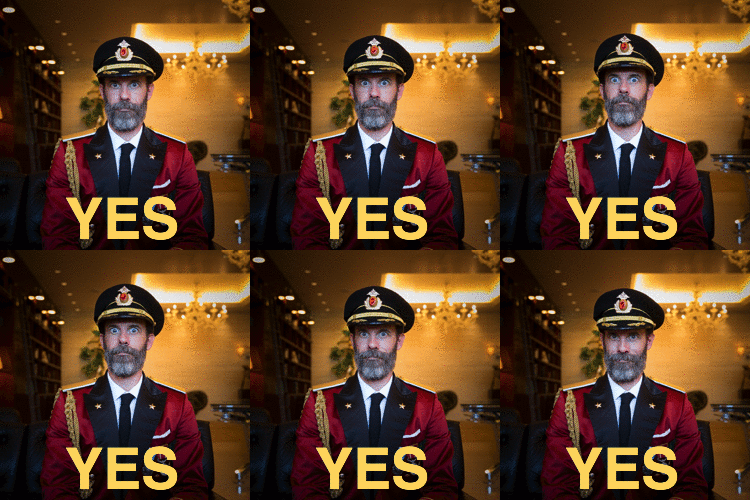
Yes Men

     .

One of the great problems facing people in power is the propensity to surround themselves with “yes men.” Once you have money or power, it is human nature to seek adulation and reinforcement rather than criticism.

This is not unusual, it tends to be the norm. I recall my father, a dairy farmer, meeting the Commissioner of Agriculture for New York State during the Rockefeller administration. My Dad asked him a general question of what his job was like. His response in a rather off-handed manner was: “Well my real job is to do what I can to get the Governor re-elected.” It was an accurate reflection, I expect, but not what my father, a farmer, was expecting to hear.

I never forgot that story. People in power tend to put around them people who will agree with them and under any circumstances will support them. Though I know that this will upset some readers, this is what I believe to be a real weakness in our current President and his administration. If you are soft-spoken yet strong, let’s say like General Mattis, you won’t be long in your job. Better to be a vocal supporter and obliging… more like Secretary of State Pompeo. When the history books are written about the Trump administration, a lot of it will probably be about the “yes men” who got it wrong.

When the history books are written about the Trump administration, a lot of it will probably be about the “yes men” who got it wrong.

Lest I be criticized of being totally partisan, I would assert that the same kind of problem is what has sometimes gotten our own Governor into trouble. Some of the people closest to him who were responsible for his Upstate economic development programs are now going to jail. They wanted to please the Governor and execute his policies even if that meant stepping outside the law. It would have been better if they had stood up and said “No” more often.

The “yes man” problem is not only the province of government and politics. It happens also in business. Recently a car company executive is purported to have used company funds to throw his own opulent wedding party at a chateau near Versailles. Where were the advisors who should have said “No?”

Are there examples of doing it differently? The answer is “Yes,” you don’t always have to have “yes men” around you.

Two examples in politics come to mind. Doris Kearns Goodwin wrote a book about Lincoln titled “Team of Rivals.” President Lincoln intentionally appointed people to his cabinet who disagreed with him and didn’t like each other. One was a politician who had run against him and who had a history here in Chautauqua County as a real estate mogul with the Holland Land Company, William Seward. Lincoln made Seward Secretary of State, and he ended being one of the Presidents best advisors on politics and foreign affairs. He also maintained his interest in real estate and ultimately engineered the purchase of Alaska from Russia for a pittance.

Another President known for appointing those who opposed him was Franklin Roosevelt. After Frank Knox ran as the Republican Vice Presidential candidate in 1936, Roosevelt named him Secretary of the Navy. After defeating Wendell Willkie, a Republican, in the political campaign for President in 1940, Roosevelt appointed him as a personal overseas envoy during World War II.

In other words, strong and successful Presidents (or business executives) are not afraid of criticism, opposition or differences of opinion. They are inquisitive and welcome it. That is the way they find out what the truth is. Speaking truth to power is important.


Rolland Kidder
This commentary originally appeared in The Post-Journal on February 17, 2019.


Saturday, February 2, 2019

A Special Breed of Fishermen


It is that time of year again when the ice fishermen dominate the landscape of Chautauqua Lake. (My definition of these individuals also includes women who fish through the ice.)

Many of them are the same as those who fish by boat in the summertime but, in my view, ice fishermen are in many ways a special breed. Some of what they do is about catching fish, but a lot of what they do is about tangling with the elements and the ice.

They sit by themselves, with their back facing the wind - the way cows do in a summer rainstorm.

There are a few loners who come with their five-gallon bucket which is used as a seat, a container to carry equipment, and a grocery bag to carry fish home if they get lucky. They sit by themselves, with their back facing the wind—the way cows do in a rainstorm in the summer. They might say “hi” to a passing fisherman but they don’t divulge their deep secrets of what they are catching or how.

However, most ice fishermen come in two’s, three’s or four’s. They don’t seem to talk a lot but there is mutual reinforcement when you can bounce off your buddy the depth at which you got a bite or what lure might be working best. Or, if you are fishing with one of your kids, then there is the satisfaction of knowing that you are passing on something of life-long value. Elemental and simple conversation is best on the ice. It is probably not a place to talk much about religion or politics.

Unlike fishing in the summer, there is no boat noise or boom boxes with music blaring from a ski boat. There is just the sky, the wind and the ice. It is quiet and awe-inspiring for the most part. As the ice gets thicker, a snow mobile or two may come down the lake. But, they are usually just passing through and not serious intruders.

I have noticed a few changes over the years. There are more multi-colored pop-up tents to block the wind out on the ice. There are also changes wrought by electronic fish-finders. An ice fisherman newly arrived may wander around a bit looking for fish beneath the surface with his device. However, if he is here for a second day, he may well walk in a straight line to the exact place he was fishing the day prior where he had already found fish. There is probably a good chance the fish are still there.

There are a couple of unchanging things about ice fishing. If numbers of fishermen mean anything, dusk still seems the preferred time to fish. A spouse waiting at home may have to delay dinner until after the sun goes down and her fisherman gets off the lake.

And then there is the walleye—still the tastiest and most preferred fish to catch. There is nothing like the savory taste of fresh walleye taken from the lake, and the good news is that there are still plenty of them being caught.

A cold, clear day turning to night with an almost limitless horizon of sky while catching a walleye through a hole in the ice that you have cut yourself…how does it get any better than that?


Rolland Kidder
Stow, New York


unsplash-logoCarlos Santos

Monday, January 21, 2019

Thoughts on Wall Building


It wasn’t too long ago that President Reagan in a speech in Berlin exhorted the leader of the Soviet Union to “tear down this Wall!”  Now we are talking about building one of our own along the entire Mexican border.

I must admit early on that I am not much of a fancier for walls resolving anything. If they are built permanently and “real big,” then they might someday become a tourist attraction — like the Great Wall of China. But, even in its day, the Great Wall didn’t help much to stop the eventual destruction of the Ming Dynasty. It wasn’t the threat of Mongol hordes overrunning China as much as the internal rot of the entrenched dynasties themselves that precipitated their failure.

If anything, walls give you a false sense of security. Fences may keep the “riff-raff” out of your backyard for a while, but eventually, without neighborliness prevailing, the neighborhood will fall apart. Fencing someone out means that you are also fencing yourself in.

Fencing someone out means that you are also fencing yourself in.

For centuries, hard borders around the nations of Europe kept national identities homogeneous; but they also guaranteed a lot of wars. People were never satisfied as to where the fences should be and so the solution was to go to war in order to expand your backyard. Frankly, I have been heartened by the development of the European Common Market, the Euro and the establishment of a European federal union of sorts. It hasn’t been perfect, but it has expanded the concept of what is the “common good” in an area of the world which has had a long history of war.

Another experience of my own makes me suspicious of walls. I am a veteran of the Vietnam War and at the end of that whole sad episode, people found a way to escape — primarily by small boats. If we totally blocked land access from Canada and Mexico with border walls, wouldn’t it be reasonable to expect that our shores could then become subject to “boat people” arriving to become U.S. citizens? Then would we have to build fences all along our coasts in order to keep ourselves safe? Border walls in front of beach condos? I don’t think so, but where would it stop?

At the end of the day, philosophically, I just don’t like fences or walls. They may be needed to contain livestock or even pets and required to imprison convicted felons. But, for human beings in general, I think they are a surrender to fear and insecurity. If people enter our country illegally, they should be prosecuted or dealt with under the law. But walls every place? Not for me. In America, it is the very idea of our being a free and law-abiding people which should be our best defense. I have heard enough of walls.


Rolland Kidder 
This article first appeared in The Post-Journal on Jan 20, 2019


Sunday, January 6, 2019

How Do We Save Rural America?


There was a recent article in the New York Times by Eduardo Porter addressing the “hard truths” of what is happening in rural America. It was compelling in the sense that it brought home the story of what I see happening here in Chautauqua County.

Some of the facts it stated were worrisome:
  • Rural America is getting old. The median age is 43, seven years older than city dwellers.
  • Since the 2008 recession, counties with less than 100,000 people lost 17,500 businesses whereas Counties with more that 1 million gained 99,000 new firms. 
  • Manufacturing remains the strongest sector in rural America, but today there are fewer than “13 million workers in manufacturing across the entire economy.”
  • In the “Eastern Heartland,” that area “roughly between the Mississippi River and the Atlantic coast, rural communities are doing particularly poorly.”
  • We are experiencing “agglomeration” throughout the economy: “Innovative companies choose to locate where other successful, innovative companies are. That’s where they can find lots of highly skilled workers. The more densely packed these pools of talent are, the more workers can learn from each other and the more productive they become.”

A light went off when I thought about “agglomeration.” Why would Amazon choose two new headquarters right in the heart of New York City and in the Washington, D.C. metro area? These places are already over-populated with jammed highways and high costs of living. Answer: agglomeration! They want high-powered, concentrated pooled talent in one place. Rural America was never a consideration in Amazon’s decision. Even medium sized cities like Columbus, Ohio had no chance in this competition. Now, Google has announced that they are also ramping up employment in these same areas, and Apple is opening another headquarters in Austin, Texas which is already a tech center.

So, in light of these economic facts, what do we do in rural America? Is there a way for us to get some of our young people to return home? Is there a plan to rejuvenate rural America? As the article warns: “What if nothing really works?… Do we “return depopulated parts of rural America to the bison?”

The article concluded with these words: “The distress of 50 million Americans should concern everyone. Powerful economic forces are arrayed against rural America and, so far, efforts to turn it around have failed. Not every small town can be a tech hub, nor should it be. But, that can’t be the only answer.”

Rolland Kidder 
This article first appeared in The Post-Journal on Jan 6, 2019


unsplash-logospecphotops