Saturday, June 6, 2015

Memorial Day Brings Poignant Memories For Veterans

Editorial from the Jamestown Post-Journal, May 24 2015

The Florence American Cemetery is pictured in the background. Pictured above, clockwise from left, Mike Lamancuso, foreground, with three friends in Italy in 1944; LaMancuso, a World War II combat infantryman, at his home; the gravesite of a soldier from the 361st Regiment, 91st Infantry Division, Elson Behnke, who was killed on Oct. 9, 1944.

by ROLLAND E. KIDDER

There can be poignant memories for military veterans when it comes to Memorial Day. Their remembrances are often specific, filled with names of those they knew who didn’t come home. So it is for Mike LaMancuso, a World War II combat infantryman. It is a day he remembers his buddies who didn’t come back from the fighting in Italy.

Mike was wounded on Friday, Oct. 13, 1944, hit in the leg by a bullet from a German sniper. Four days earlier, on Oct. 9, another soldier from the 361st Regiment, 91st Infantry Division, Elson Behnke, wasn’t as “lucky.” He was killed in the same area. Two young American soldiers, far from home, one wounded, one killed, linked together by an American Army Division fighting to liberate another country. Mike made it home. Elson Behnke is buried at the Florence American Cemetery, near the battlefield where he fell. Though they hadn’t personally met, it is men like Elson Behnke that Mike LaMancuso thinks about on Memorial Day.

Mike has been back to Livergnano, Italy, where he was hit on a Friday the 13th that he will never forget. At the time, Mike’s outfit had been in ferocious combat with the Germans along what was called the “Gothic Line,” Germany’s last major defensive line in the mountains north of Florence. It was the same general area from which two future U.S. Senators, Bob Dole and Dan Inouye, would be medevac’d because of their wounds.

The way Mike describes it: “I could speak Italian, but most of the GI’s couldn’t, so they called the place I was wounded ‘Liver and Onions.’ We had gotten ahead of our lines and were pretty much surrounded by the Germans. We had taken cover behind a house, but were still exposed to enemy fire, and a German sniper shot me in the leg, breaking it in two places. Our unit had to wait until dark before they could get me back to a battalion aid station for treatment.”

Today, over 70 years later, it is hard to believe that the beautiful, pristine countryside near Florence could have been a killing field. But the cemetery reminds you — 4,398 headstones and 1,409 names on the Wall of the Missing, mark the struggle and are a testament to the sacrifice and bravery of American soldiers during the Second World War.

Most Americans who travel to Italy want to visit Florence to see the incredible art and architecture of the Italian Renaissance. While there, they should also take the 20-minute trip southwest toward Siena to experience the silence and awe of the Florence American Cemetery. It makes you proud and humbled to be an American. It is an especially powerful visit on Memorial Day, when there are American and Italian flags flying at each grave marker on this sacred ground.

Another way to remember Memorial Day, if you are celebrating it here at home, would be to stop and thank Mike LaMancuso and those like him who 70 years ago were fighting for values Americans deeply believe in, in far off places like Livergnano (“Liver and Onions”), Italy.

Rolland Kidder is a commissioner of the American Battle Monuments Commission, which is responsible for the care and maintenance of 25 overseas American military cemeteries.


Friday, April 17, 2015

A Great Year for Golf!

One of the passions I have acquired later in life, is a love and respect for the game of golf. It is not because I am a good player though, in the summer, I usually Tee-it-up at least once a week. It is a game which requires discipline and no excuses… it is you against the golf course. Everyone is measured by the same opponent—the golf course. It is also a game with a rich history, including what I believe is the “tournament of the year,” held every year at the same course, Augusta National.

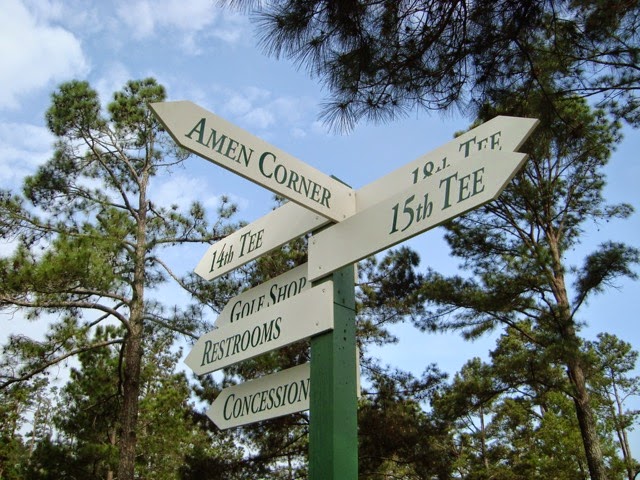
I am not a big one for “bucket list” items but this year I was able to see one to fruition—getting my sons and son-in-law to Augusta to view a practice round at The Masters. If you have never been, you should try to go. It is like walking in a Garden of Eden as you move along with the players around this course. It also gives you a chance to appreciate the magic of Bobby Jones in supervising the construction of this magnificent course—the way it ebbs and flows from the high ground around the clubhouse down to the bottom land around Amen Corner and Rae’s Creek.

Here we all are in front of the Leader Board at Augusta last week and quite an event it was for golf. A new generation of golfers announced their arrival on the scene with the magnificent play of 21 year-old Jordan Spieth highlighting the tournament.  It couldn’t have been better.  It was a spectacular year to be at the Masters!

Rolly


In front of the famed Leaderboard
Rolly channeling the great Bobby Jones 
We spent the afternoon overlooking the Hogan Bridge at Amen Corner 
Bubba heading to the 17th tee
A final toast to Tradition on the way home
Quoting my wife Jane: "Didn't we all know it would end up like this"

Sunday, March 29, 2015

Red's Sugar Shack


We've had a long, 
cold winter here in western New York.  One event we look forward to is maple syrup season.  Here, members of the Dawson/Kidder family have just finished a delicious breakfast of sausage, pancakes and maple syrup at Red's Sugar Shack in Sherman, NY.  It is a definite sign that spring is on the way and summer is not far behind!

       - Rolly


Saturday, March 14, 2015

Live Audio from an OV-10 Bronco "Black Pony" air strike

Excerpted from Backtracking in Brown Water, by Rolland E. Kidder


A U.S. Navy Rockwell OV-10A Bronco of light attack squadron VAL-4 Black Ponies attacking 
target with a 12.7 cm (5 in) "Zuni" rocket in the Mekong Delta, South Vietnam, ca. 1969/70. 


00:15  /  The first part of this tape is a re-recording of an OV-10 Bronco air strike on the Vinh Te Canal.  I am listening to and recording the events of a previous night when a PBR boat captain had recorded the sounds of this air strike.   He and I are laughing and commenting on what occurred.   At one point, a siren goes off, the signal to stop firing.  Then a Vietnamese sailor yells at a local outpost for them to cease firing.  The outpost had been firing mortars into an area where these Navy strike aircraft (with the call sign “Black Pony”) were flying.   From the tape, you can hear metal falling on the deck of the PBR as the machine guns are fired.   Tracers from PBR machine guns were often used to support air strikes by marking the location of enemy positions.  The sound of the twin engine OV-10’s can be heard as they fly low over the boat on their strafing runs toward the target.

04:15 / On October 26, 1969, I tape-recorded the radio traffic during an enemy attack against our heavy River Assault Group boats.  The position of our PBR was about a mile from the encounter.  We could see the firefight in the distance.  The call sign for the RAG boat commander was “Brass Rail”, and individual boats under attack are designated by various letters of the phonetic alphabet.  U.S. Navy Seawolf helicopters and fixed wing Black Pony attack aircraft can also be heard calling in.  A RAG boat radio sometimes remains keyed in the “on” position and you can hear yelling and firing in the background. The tape accurately describes the chaos, anxiety and fear experienced in a firefight.  


AUTHOR'S NOTE:
Since publishing Backtracking in Brown Water, I continue to receive inquiries about this firefight audio link found on page 130.  The QR code provides readers with a direct link to audio files I submitted to the Internet Archive, a non-profit digital library dedicated to preserving artifacts of culture & heritage.


The recording itself came from a tape recorder that I had taken on one of the multi-day patrols on the Vinh Te Canal. (It was one of those small, cassette tape recorders that I had purchased in a Navy PX someplace.) While in Vietnam, I periodically sent tapes home to friends and family instead of writing a letter. On this occasion, I used it to actually record some of the "goings on" on the Vinh Te Canal. The first vignette includes some background discussion between myself and a boat captain of an airstrike he had recorded a prior night. The second occurs on another night when I turned the recorder on during a firefight between the enemy and the RAG boats.  

Fortunately, when I got back to the YRBM 20 after this patrol, I made some copies of the tape. One of them got to an Admiral who queried Mike Connolly about it (see page 125)

Tuesday, February 24, 2015

Oil by Pipeline or by Rail?


Unless you are ready to give up driving, you should probably be thinking of how oil can best be transported across the country so that it can be converted into gasoline and ultimately fuel your car. (These days, you might be able to shift your choice of automobile fuel to electricity, but that doesn’t change the issue much since oil and other fossil fuels are also the major source of making electricity in the United States.)

The Congressional Research Office recently published a very informative research paper on the matter and, as with most issues, there are “pros and cons.” What was clear though is that transportation of oil and oil products by truck is the riskiest way to move it. There are more chances for spills and the track record for trucks isn’t nearly as safe as for pipelines or railroads. That interested me because here, at the local level, all of our gasoline and oil products are transported to the customer by truck.

Though we hear a lot of noise about shutting down pipelines and oil tanker railcars, no interest group or elected official has, to my knowledge, advocated shutting down gasoline stations where tanker trucks regularly pull in to deliver needed fuel for our automobiles. I expect that polls have shown that voters, no matter what their political persuasion, would not react kindly to empty gas tanks with no fuel to operate their cars. So we are stuck with truck transportation of petroleum products at the retail/local level.

But, what about the transportation of oil and oil products across the country, let’s say from North Dakota to New York, or Texas to New Jersey? If we did it by truck, we would have to put a million more trucks on the road. Nobody is for that and it would be outrageously expensive. Thus, the choice comes down to pipelines or rail.

In terms of the amount of oil spilled, since most oil has (until recently) been transported by pipeline, most spills were related to pipeline failures. However, things are rapidly changing. Because of the growth in domestic production and since it has become difficult to receive government approval for pipelines, more oil is now moving by rail. In 2013, there was more oil spilled from railcars than during the previous 37 years. Why? Because much more of it is now moving to market by rail.

If you measure safety by human tragedy, there has been no recent history as tragic as the oil train derailment in Quebec two years ago where 47 people died. Though without the comparison in loss of life, we were reminded again recently of the risks of using rail when 26 oil tank cars derailed and caught fire in West Virginia.

So that brings us back again to pipelines. Pipelines have historically moved about 99.99% of the oil they ship to market without major incident. Their construction and safety standards are heavily regulated (as they should be) by the federal government. Those who want to live in a completely risk-free universe will probably continue to oppose them. But, for most of us, who want gasoline in our tanks, pipelines would seem to be the logical and preferred way to move oil and petroleum products across the country.

We live in a great country and are fortunate that, in recent years, we have become less dependent on Mideast oil. Now, we just have to figure out how best to move our domestic oil production to market.

Rolland Kidder
Ashville, NY

Mr. Kidder was a Democratic member of the New York State Assembly from 1975-1982 and a member of its Environmental Conservation Committee. He is former owner and founder of a Western New York natural gas exploration company.

Contact Info:
716-789-4620
rolland.kidder@gmail.com

Monday, February 2, 2015

Compelling History from a Vietnamese American

After reading Backtracking in Brown Water, a friend now serving in the military suggested that I read the book A Thousand Tears Falling by Yung Krall. It is a book I should have read many years ago. If you served in the Mekong Delta during the War, you will find it hard to put down.

Yung Krall, A Thousand Tears Falling

Krall grew up in the Mekong Delta where her father was a leader in the Viet Minh which ultimately became the Viet Cong. Some of her earliest memories were of ducking for cover when her village was being strafed by French aircraft. Her village was described as a “liberated zone” which meant that the French no longer controlled it.

When she was a small girl, her father left to represent the South with the Viet Minh in the North. She didn’t see him for 18 years. Ultimately, Hanoi’s fight shifted from the French to the Americans. Krall and her sisters were raised by their mother. A brother followed his father north to Hanoi. It is a classic story of how families get ripped apart in a civil war. A hundred and fifty years ago, had she lived in a border state like Kentucky, the same kind of thing was happening in this country.

To make a long story short, she couldn’t support the communist approach to governing and the dictatorial way they approached those who lived in the Delta. She eventually moved to Saigon, worked for the Americans, married an American and eventually moved to the United States. Though she loved her father, she couldn’t accept his political decision to leave the family and move to the North. She met him finally in Paris after the war was over, where he was serving as a diplomat for the new Vietnamese government.

When we think about Vietnam and the sacrifices made by those who served there in the U.S. military, we sometimes forget about what happened to the Vietnamese who supported our efforts. This is a good book about that. It was written in 1995 and can be purchased “used” online. I found it to be a compelling and powerful narrative, and would recommend it to Vietnam veterans. It helps “fill in the gaps” of what our own experience was all about.

Rolland Kidder

Sunday, January 18, 2015

A Navy Man Reconnects / USS Surfbird ADG-383


"Though we only spent a relatively short time together in the Navy, that common experience continues to be the catalyst for maintaining long term friendships."

In writing the book, I referred primarily to my Navy experience on PBR’s in Vietnam. However, prior to going to Vietnam, I had served as Operations Officer on a ship, USS Surfbird ADG-383, which was home-ported in Japan. 

In writing about my R & R trip back to Japan, I mentioned this ship (p. 172) and this week, out-of-the blue, got an email from an old, fellow sailor, Bruce Stevens. To be honest, I can’t remember a lot of the names of men I served with on that ship. However, he had signed his email: “BM 3, 67-70.” That meant he had been Boatswains Mate 3rd class in 1967-1970.

When I responded to his email, I asked him if we had served together, and he sent me a wonderful letter naming various people we had both served with on that ship. He has maintained his friendship with them over many years. Bruce said that he had read the book and “enjoyed it very much.” But, of course, our correspondence dealt primarily with our old comradeship on the USS Surfbird.

One of the benefits of writing a book comes when it helps resurrect old friends and old memories. This reconnecting also is indicative of Navy men. Though we only spent a relatively short time together in the Navy, that common experience continues to be the catalyst for maintaining long term friendships. I am sure the same thing goes on today for those who serve on ships in the Navy.

Rolly Kidder

Friday, January 2, 2015

French "Dinossaut" Riverine Craft

For those who served on the Mang Thit River, 1969, these were the type of boats that were operated by the South Vietnamese Vinh Long Battalion. Captain Bob Olson, who died during this operation, and Mike Paluda both operated as Army advisors with this outfit. The boats were reliable but slow and made a lot of noise. The Vinh Long Battalion was associated with the PBR effort here to open the Mang Thit to commercial activity. The VC had closed the waterway, primarily by taxing boat traffic, and the U.S./Vietnamese effort here was successful in reopening the river to commercial traffic.  This note below is repeated from Mike Harris, of the Mobile Riverine Force Association.

Rolly Kidder

---------------------------------------

Hello Everyone, 

First, allow me to pleasure of wishing you all a very good 2015! 

Rich Lorman (T-152-6 — 7/68 to 6/69) sent me the query on this photo:
Here's a photo of a totally new version of Riverine craft I hadn't seen before: 


It is actually an altered version of the old French Dinossaut (STCAN/FOM) craft. The bow has been cut off as you will see below. Probably due to damage. These are like the one that I spotted sanded in on the shore in Northern Laos in the mid-90’s (see below). I just found this model on the Internet. There were two sizes. 8 meter and 11 meter: http://fieldsoffireonline.freeforums.org/stcan-fom-boats-t1873.html 


Here’s an image that I found on the Internet years ago. I believe that it is in Ed Marolda’s “By Sea, Land and Air”. I seem to recall that LT. Meyerkord received the Navy Cross Medal earlier in the 60’s as a Naval Advisor on these boats. 


This is the one in Northern Laos. I wish that I could have initiated a salvage of the craft, but it would not fly in communist Laos. FYI, the boat in the background was very unique. It had a 4 cylinder car engine and very little keel. We were given motorcycle helmets and looked like we were on a Shuttle launch the way our facial skin pushed back due to the speed of the boat. They slid around bends so the driver had to really know the boat. 

Here is a nice article I just found on the Dinossaut boats. Click on any underlined craft and scroll through photos of all of the different boats. We all saw many of these craft still in operation when we were there. Interestingly several of them had 20 MM weapons as well: http://indochine54.free.fr/cefeo/dinassau.html 

Here’s an old video of a “French Commando Raid”. Looks pretty staged though: http://www.britishpathe.com/video/indo-china-french-commando-raid 

Warm Regards, 
Mike Harris

Wednesday, December 24, 2014

A Merry Christmas from Our House to Yours

Christmas is a great time around our home, and we hope it also is for you.

Two years after returning from Vietnam, I married Jane Dawson and ever since we have celebrated what we call the “Dawson Christmas.” It is held a few days before Christmas so that all of the Dawson’s can drive in from places like Rochester and Cleveland. This past Sunday we had about 35 of us together at our home here on Chautauqua Lake. When Santa came, the place erupted with all of the grandkids cheering his arrival! If you play this short video, you will get a sense of what it was like.

We wish you all a Merry Christmas and Happy New Year!

Rolly Kidder


Wednesday, December 3, 2014

New Revisions now in effect for Backtracking in Brown Water

As I stated in the Acknowledgements chapter of my book, book-writing can take on a “complexity of its own.”

There were two factual changes that I needed to make to the book and several grammatical improvements that make it better. Our editor, Ruth Fairbank Chiama, helped me in getting this done. She also sent me a copy of some comments made by Charles Krauthammer in his book Things That Matter.  Many of his chapters were adaptations of prior newspaper articles. When he put them into book form he made some changes, minor in nature but focused on “allowing me to exercise my petty punctuational prejudices, most importantly, my war on commas.  They are a pestilence and must be stopped.”  But, he assured the reader that “they change no meaning…. It stands on the day it was first published: imperfect, unimproved and unapologetically mine.”

That, in essence, describes these most recent changes to Backtracking in Brown Water.  If you have already read the book, you need not purchase another copy.  But, for those first-time readers or potential readers, I think this “tweaking” makes the book better and, at least, puts the author’s mind at ease that it better passes muster from a grammatical and punctuational point-of-view.  If you haven’t yet read the book, now would be a good time to purchase it!

Rolland Kidder

Monday, December 1, 2014

Return to the Mekong Delta


This map traces my journey back to South Vietnam which inspired Backtracking in Brown Water

Saturday, August 16, 2014

Natural Gas Advocacy

In addition to my interest in veteran’s affairs as witnessed in Backtracking in Brown Water, I have for many years been involved in the energy business and specifically in natural gas as an energy source.  My son, Bart, co-author of this blog, has suggested that some of our readers might be interested in my views as they relate to current policy in the State of New York which has shut-down the natural gas drilling business. 


Because of my concerns about what I view as a short-sighted energy policy, I have written a few articles advocating on behalf of natural gas as a clean-burning resource which should be developed in our state.  The following article is one of a series that were sent to daily newspapers across New York State.

Who Will Supply New York with Natural Gas?

Today, new technologies for unlocking natural gas have revolutionized the industry.   A half-century old process called hydraulic fracturing combined with a relatively new ability to drill horizontally in shale formations has made America more energy independent than it has been in fifty years.  The Marcellus Shale, conveniently located here in the Northeast, has become one of the biggest international energy stories emerging in the past five years.

Yet, New York has decided to “opt-out” of participating in this economic opportunity.    That does not mean that our state does not like to consume natural gas.   According to statistics published by the U.S. Energy Information Administration (EIA), in 2012 New York consumed 1.2 trillion cubic feet of natural gas.   Statewide, 29% went to heat homes, and 40% was consumed to make electricity.  

So what has New York decided to do about it?   We have decided to say “No” to this new technology.  The State has essentially shut down the natural gas producing industry through a “moratorium”, a decision to not issue permits for the production of shale gas within the boundaries of New York State.

This produces a conundrum for those of us who live in this state.  We need natural gas.   We expect it to be delivered to our doorsteps, to our apartments, to our businesses… and especially to our plants that produce electricity.   We like the clean-burning, environmental benefits of natural gas, but we apparently don’t want the inconvenience of producing it. 

Where do we want to get our energy?  Do we want to go back to importing more oil from the Middle East?  Do we want to become an energy-starved country like Japan which needs to import liquefied natural gas (LNG) from other countries?   We do want to be known as the most environmentally enlightened state in the Union.   We say we are for renewable energy, yet are unwilling to support production of the natural gas required to back it up and insure its reliability on the electric grid.    In short, New Yorkers seem to have an attitude that “we can have our cake and eat it to.”  Let someone else worry about our natural gas supplies.

The most recent statistics from EIA indicate that about 34% of the natural gas being consumed in the country today is coming from shale formations.  This energy cannot be produced without these modern technologies which, in essence, release the gas that is trapped in the rock. Though we New Yorkers are sitting on billions of cubic feet of shale gas, we are unwilling to produce it.

Albany needs to “change its tune.”  Our State should be a producer, not just a consumer of this clean-burning energy. During this year’s cold winter, even the most ardent opponents of natural gas in New York were being kept warm by it.  The fact that over a third of the energy heating our homes was coming from shale gas reservoirs in neighboring states seems to be over-looked.  Where would we be without it?  Who, in the future, will supply the natural gas that we need?  Shouldn’t New Yorkers be a part of the solution?

Wednesday, July 16, 2014

Book Signing at Chautauqua Institution this Weekend!


Rolland Kidder, author of Backtracking in Brown Water,  will be signing books at the Chautauqua Institution Bookstore on
Sunday, July 20th from 12pm - 2pm 

Chautauqua Institution was founded in 1874 and is located on the shores of Chautauqua Lake in upstate New York.  Originally founded as an educational retreat center for the Methodist Church, the Institution has become one of the premier summer cultural centers in the United States.  Over a 9 week season it offers programing in theater, opera, lectureships and music.   It also hosts a Symphony Orchestra which regularly performs twice a week.   The Chautauqua Literary and Scientific Club is one of the oldest book clubs in America.  Its a beautiful setting with many things to see and do.

Gate passes to the Institution are free on Sundays.  The Chautauqua Bookstore is located on Bestor Plaza at the center of the Chautauqua grounds.  The public is invited to the book signing, we'd love to see you there!


View Larger Map


Monday, July 14, 2014

Endorsement from a Non-military Voice

Two weeks ago I received a wonderful letter from an old friend about the book.  She is an author herself, had purchased the book primarily out of wanting to support a friend, and had set in on a shelf.   When she started to read it, she wrote that “she couldn’t put it down.”  

I have received many letters of support from those who have served in military, but thought that her comments were especially poignant as being one of the many who were affected by the Vietnam War while not being directly engaged in it.  With her permission, I have copied her letter for inclusion on this blog:

Dear Rolly: 
Just had to let you know that I’ve had your latest book for some time but had postponed reading it.  I didn’t really think it would interest me but wanted to support you. 
Instead, I couldn’t put it down! I was glad to learn so many details about your experience in Vietnam, both 40 years ago and more recently.  That was where so many of my classmates found themselves.  My high school love, President of the 1960 Class of Kenmore West, totally disappointed me when he chose West Point over Princeton.  Shortly thereafter, I opted out of our lengthy relationship—a lifelong neighbor committed neighbor committed suicide upon his return stateside.  As you know, it was a time of disillusionment for all of us. 
However, I thoroughly enjoyed your book and your informative, yet personal, writing style.  I found it a page-turner, to be honest. 
You’ve done a great service to your Navy buddies and their families, to be sure.  And, I hope you have a great sense of satisfaction for completing this daunting project. 
The book was quite an eye-opener and I appreciate your taking all of us readers  backtracking with you! 
Sincere congratulations, 
Kathy Crocker